Card Connectors 101: Types, Standards & Common Applications
- Share
- publisher
- MOARCONN
- Issue Time
- Aug 29,2025
Summary
Selecting the right connector impacts device performance, durability, and user experience.
What Is a Card Connector?
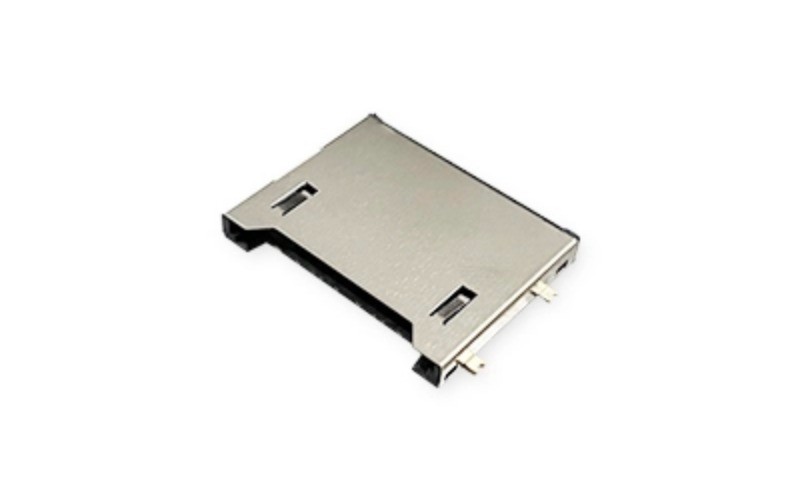
Card connectors are the electromechanical interface between a removable memory or identity card and a host board. They carry power, clock and data across a set of spring contacts, hold the card in place against vibration and shock, and — in most designs — signal the host that a card is present. They appear in phones, cameras, cars, meters, gateways, medical devices and industrial controllers, and in every one of those products they are a small part that decides whether the device works on the day it ships.
Selecting the right connector affects three things that are hard to fix later: device performance, because contact geometry and plating set the ceiling on signal quality; durability, because the spring contacts are the only part of the system that moves every time the user does something; and user experience, because insertion force and eject behaviour are what the customer actually feels.
The Four Families of Card Connectors
1. SIM and Nano SIM connectors
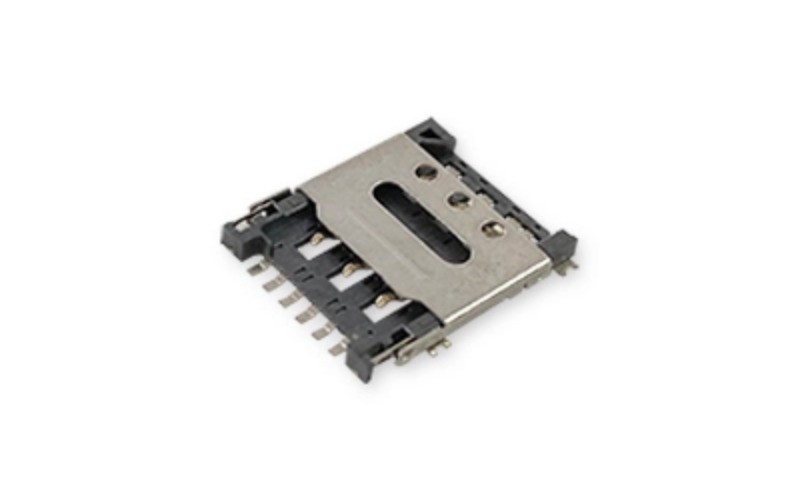
SIM sockets follow the ISO 7816 contact layout and are made in three card formats: 2FF (Mini SIM, 25 x 15mm), 3FF (Micro SIM, 15 x 12mm) and 4FF (Nano SIM, 12.3 x 8.8mm). Nano SIM connectors meet the miniaturisation demands of modern devices while keeping a contact force high enough for reliable reads, and they are now the default in phones, wearables, 5G CPE and cellular IoT modules. MOARCONN specialises in high-precision Nano SIM card connectors for 5G, IoT and industrial electronics, with profiles from 1.10mm push-pull to 1.43mm hinge type.
2. SD and microSD connectors
SD and microSD sockets carry the SD interface and come in three mechanism variants — push-push (self-eject), push-pull (direct) and hinged or flip-lock. They are the standard storage interface in cameras, drones, dash cameras, body cameras and industrial loggers, and they are increasingly specified with a second contact row for UHS-II and SD Express. MOARCONN provides SD and microSD connectors with a stable contact design that holds its electrical characteristics through repeated insertion, from 1.28mm microSD push-pull up to 3.58mm full-size SD push-push.
3. IC card connectors and reader sockets
IC card connectors accept chip cards rather than memory cards — bank cards, ID cards, health cards, access cards. They use the same eight-contact ISO 7816 arrangement as a SIM socket but in a larger housing with a card-guide and often a landing-contact design that only touches the chip when the card is fully seated, which is what gives them their very high cycle life. They are covered separately in our guide to IC card connectors and IC sockets.
4. Custom card socket connectors
When a standard housing does not fit, the connector becomes a mechanical design problem: a different height, an offset card path, an added detection switch, a waterproof gasket or a housing in a high-temperature plastic. MOARCONN runs this as a custom card socket connector service, adapting existing tooling where possible so that a project gets a 25-day development cycle instead of a new mold program.
Card Connector Comparison at a Glance
Most specification mistakes happen because two families are compared as if they were interchangeable. They are not — the contact count, the height and the mechanical life all differ by family.
| Family | Standard | Contacts | Typical height | Mechanisms | Typical use |
|---|---|---|---|---|---|
| Nano SIM (4FF) | ISO 7816, ETSI TS 102 221 | 6 or 8 | 1.10 to 1.43mm | Push-pull, push-push, hinge, tray | Phones, wearables, IoT modules, 5G CPE |
| Micro SIM (3FF) | ISO 7816 | 6 or 8 | 1.80 to 2.50mm | Push-push, push-pull, hinge | Routers, tablets, telematics retrofits |
| microSD | SD 3.0 / UHS-I, UHS-II, SD Express | 8 (+ second row) | 1.28 to 1.60mm | Push-pull, push-push, hinge, tray | Phones, drones, cameras, loggers |
| Full-size SD | SD 3.0 to SD 8.0 | 9 | 2.94 to 3.58mm | Push-pull, push-push, hinge | Cameras, dash cams, industrial terminals |
| IC card reader | ISO 7816, EMV | 6 to 8 | 3.0mm and up | Landing contact, sliding | POS, ID readers, access control |
Standards That Decide Compatibility
Compatibility is a standards question, not a supplier question. Four documents cover most of the market. ISO 7816 defines the physical dimensions and the C1 to C8 contact assignment shared by SIM and IC cards, which is why a SIM socket and a bank-card reader use the same electrical layout at very different scales. ETSI TS 102 221 defines the electrical and logical behaviour of the SIM interface, including the voltage classes the host must negotiate. SD 3.0 and the later UHS and SD Express revisions define the bus width, the signalling voltage and the second contact row that carries the high-speed lanes. JEDEC standards cover the memory packages behind embedded storage, which matters when you compare a socket against a soldered eMMC.
Compliance also has a reliability dimension. Connectors tested against IEC and industry standards are tested for insertion cycles, vibration and temperature resilience, and that testing is what separates a part that survives a warranty period from one that survives a decade. Ask for the test report rather than the compliance sentence.
What Durability Really Means on a Datasheet
"Durable" appears on every connector datasheet and means nothing until it is tied to numbers. Four figures carry almost all of the real information.
- Mating cycles. The count over which contact resistance stays in specification. MOARCONN rates 10,000 cycles, twice the national requirement, which matters for devices where the card is swapped weekly — dash cams, test fixtures, industrial handhelds.
- Contact resistance. 30mΩ or less, measured with terminals plated to at least 0.025µm of gold over nickel on phosphor bronze. Thinner plating passes incoming inspection and drifts after a few thousand insertions, especially in humid or sulfur-bearing air.
- Operating temperature. -45°C to 80°C covers automotive cabin, industrial cabinet and outdoor enclosure environments. Below that range, differential expansion between terminal and housing starts to change the contact force.
- Coplanarity. ±0.05mm on MOARCONN parts against the ±0.10 mm common in the industry, with 0.05mm max full-area solder plane flatness. This is the figure that decides first-pass solder yield on a thin board, and it is measured after reflow, not on the bare part.
Vibration belongs in the same list for anything that moves. Devices built for vehicles and transport should be qualified to ISO 16750-3, and MOARCONN supplies that vibration data for automotive programs alongside ISO 9001, ISO 14001 and IATF 16949 certification.
Where Card Connectors Are Used
Consumer electronics: smartphones, tablets, wearables, cameras and audio players, where height and insertion feel dominate the specification. Industrial electronics: smart meters, gateways and handheld terminals, where cycle life and contact stability over years matter more than profile. Automotive and IoT: navigation, telematics, dash cameras and edge computing devices, where thermal cycling and vibration decide the outcome. Medical and security: diagnostic devices, patient monitors, POS terminals and access-control readers, where retention, cleanability and tamper evidence are part of the requirement.
How to Choose in Five Steps
- Fix the card format first. Nano SIM, microSD or full-size SD is decided by the product, not by the connector supplier.
- Fix the mechanism by duty cycle. Swapped weekly: push-push or hinge. Fitted once: push-pull is cheaper and simpler. Sealed device: consider a soldered MFF2 SIM or embedded flash instead of a socket.
- Fix the height, then check coplanarity. Height sets the footprint; coplanarity sets the yield.
- Match the electrical grade to the interface. UHS-I needs controlled impedance; UHS-II and SD Express need a second contact row and a differential pair, which cannot be retrofitted without a respin.
- Match the environmental grade to the installation. Automotive and outdoor products need the wide temperature rating and the vibration evidence; a consumer product does not need to pay for either.
Why Choose MOARCONN?
Original manufacturer advantage. MOARCONN manufactures rather than trades: in-house mold, stamping and injection molding, 141 card socket models across 13 series, and direct factory pricing with consistent quality.
Engineering depth. Advanced production lines and an in-house design team support 32 granted patents, and original-factory FAE answers technical questions within 24 hours.
Customisation service. Pin configurations, housing heights and mechanisms can be adapted to fit a specific product, with 0 MOQ, 7-day sampling and a 25-day development cycle.
Supply support. Stable lead times and scalable production cover both the prototype stage and mass production, with samples retained for 3 years for traceability.
Card Connector FAQ
What is the difference between a card connector and a card socket?
The terms are used interchangeably in the industry. "Connector" is the general term for the electromechanical interface; "socket" usually implies the receptacle that the card plugs into, as opposed to a header or a plug. When a supplier lists "card socket connectors" they mean the board-mounted receptacle that accepts SIM, SD or IC cards.
Which connector family should a new IoT device use?
Nano SIM (4FF) for cellular connectivity, microSD for removable logs. If the device is sealed and provisioned remotely, a soldered MFF2 SIM and embedded flash remove two mechanical failure modes at the cost of field replaceability. Most industrial designs hedge: socket for the SIM where the carrier is decided at deployment, soldered flash for firmware, microSD socket for user data.
How many insertion cycles do I need?
Count the real duty cycle rather than choosing the biggest number. A sealed consumer device sees a handful of insertions; 5,000 cycles is already generous. A dash camera or a test fixture sees weekly swaps and should be specified at 10,000 cycles, which is twice the national requirement and also a useful proxy for terminal and plating quality.
Can one connector support SD, SDHC and SDXC cards?
Physically yes — the three share the same card dimensions and contact layout, and the host controller negotiates capacity and speed class. What changes with the card generation is the interface speed, so a socket specified for UHS-I will accept an SD Express card in some cases but run it in the legacy mode. If you need the higher speed, the second contact row has to be specified from the start.
MOARCONN Quality Anchors
Every MOARCONN card socket connector is validated to 10,000 mating cycles (tested to GB/T 5095.7-1997; over 2× the 3,000–5,000 cycles common in the industry), operates from -45°C to 80°C, and ships with contact resistance ≤30mΩ thanks to ≥0.025µm gold-plated phosphor-bronze terminals. IATF 16949 certified production supports 0 MOQ orders with 7-day sampling and a 25-day development cycle — backed by in-house mold, stamping and injection molding factories and 32 granted patents.