Custom SIM Card Connector Design & Manufacturing Notes for Advanced Embedded Systems
- Share
- publisher
- MOARCONN
- Issue Time
- Jun 9,2026
Summary
Custom SIM card connectors for embedded systems. Design, manufacturing & reliability guide for IoT and automotive.
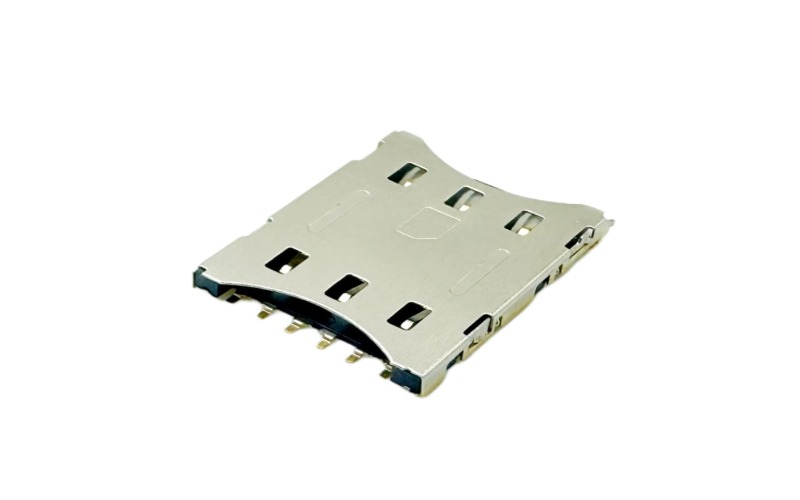
Custom SIM Card Connector Design & Manufacturing Notes for Advanced Embedded Systems
Introduction
In modern embedded systems, SIM Card Connectors play a critical role in ensuring reliable cellular communication. While often perceived as a simple electromechanical component, the SIM card connector directly impacts signal integrity, device durability, manufacturability, and long-term system stability.
For advanced embedded applications such as IoT gateways, industrial controllers, automotive telematics, and outdoor devices, standard off-the-shelf SIM connectors are not always sufficient. Custom SIM card connector design—combined with a controlled manufacturing process—is often required to meet strict mechanical, electrical, and environmental demands.
This page provides engineering-focused design and manufacturing notes for custom SIM card connectors, helping hardware engineers and product developers make informed decisions from concept to mass production.
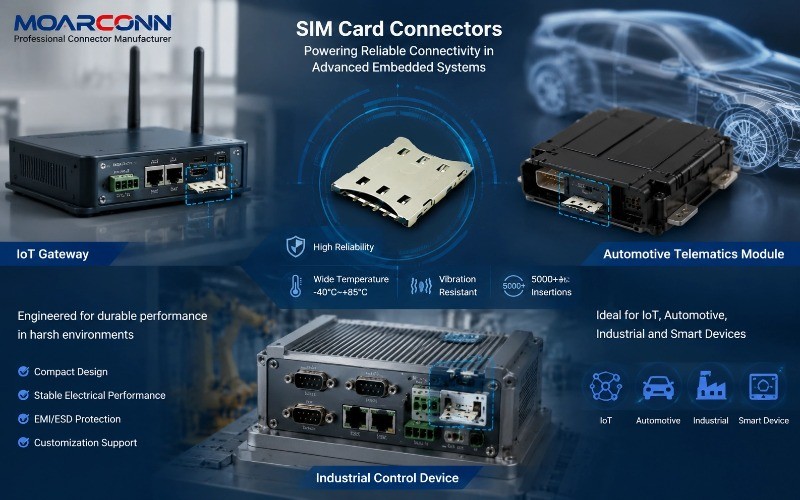
1. Why Custom SIM Card Connectors Matter in Embedded Systems
Standard SIM card connectors are typically designed for consumer electronics with predictable usage environments. In contrast, embedded systems often face:
Limited PCB space and strict height constraints
High vibration and mechanical shock
Wide operating temperature ranges
Long service life with minimal maintenance
Higher requirements for EMI/ESD robustness
In these scenarios, custom SIM Card Connectors allow engineers to optimize:
Mechanical structure and retention force
Contact layout and signal reliability
Mounting style and assembly compatibility
Environmental resistance and lifecycle performance
Custom design reduces failure risk and improves overall system reliability—especially in mission-critical applications.
2. Core Structure of a SIM Card Connector (Engineer’s Perspective)
A typical SIM card connector consists of:
Insulating housing (LCP, PA9T, or high-temperature polymers)
Metal contacts (copper alloy with surface plating)
Card guiding and retention mechanism
Optional EMI shielding shell
Each structural element affects insertion force, contact stability, and manufacturing yield.
2.1 Contact Design and Reliability
Contact geometry and spring force must ensure consistent electrical contact under vibration and temperature changes. Gold plating is commonly used to minimize contact resistance and corrosion.
Engineering note:
Excessive spring force increases wear; insufficient force leads to intermittent contact—balance is critical in custom designs.
3. Insertion & Ejection Mechanism Selection
Different embedded applications require different insertion mechanisms:
Push-Pull – simple, cost-effective, suitable for industrial devices
Push-Push – user-friendly, common in consumer electronics
Hinged / Tray-Type – improved vibration resistance, ideal for automotive systems
Custom SIM Card Connector projects often modify these mechanisms to optimize ergonomics, durability, or space utilization
4. Materials and Electrical Performance Considerations
4.1 Contact Materials & Plating
Common contact materials include phosphor bronze or brass. Surface treatments typically involve:
Nickel under-plating
Gold plating on contact areas
Gold thickness directly affects connector lifespan and electrical stability, especially in low-signal SIM interfaces.
4.2 Housing Materials
High-performance plastics such as LCP and PA9T are widely used due to:
High thermal resistance for reflow soldering
Dimensional stability
Low moisture absorption
Material selection is a key part of custom SIM connector engineering.
5. PCB Integration and Layout Guidelines
Proper PCB integration is essential for SIM Card Connector reliability:
Place the connector near the PCB edge for accessibility
Keep SIM signal traces short and impedance-controlled
Isolate SIM signals from high-frequency RF sections
Add ESD protection components near the connector
Well-designed PCB layouts significantly reduce field failures related to SIM detection and communication errors.
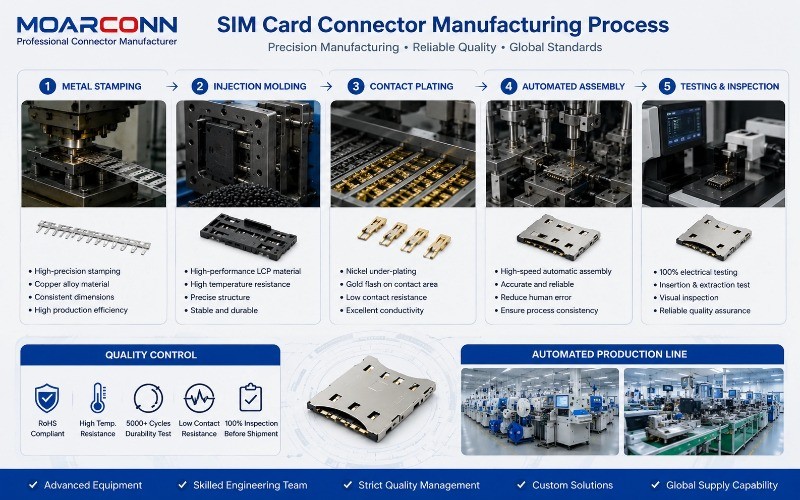
6. Manufacturing Process: From Design to Mass Production
High-quality SIM Card Connectors require tightly controlled manufacturing processes.
6.1 Precision Stamping
Copper alloy strips are stamped using high-precision tooling to form contact terminals with consistent geometry.
6.2 Surface Plating
Contacts undergo controlled electroplating to achieve uniform nickel and gold layers, ensuring electrical and mechanical reliability.
6.3 Injection Molding
Connector housings are molded with tight tolerances to ensure accurate contact positioning and smooth card insertion.
6.4 Automated Assembly & Testing
Final assembly is typically automated and includes:
Contact insertion
Housing assembly
100% electrical continuity testing
Insertion force and retention force inspection
7. Reliability and Qualification Testing
For embedded systems, SIM Card Connectors are commonly tested for:
Insertion/extraction life (1,500–10,000+ cycles)
Thermal cycling and high-temperature exposure
Vibration and mechanical shock
Contact resistance stability
ESD resistance
These tests ensure long-term performance in harsh operating environments.
8. Application Scenarios for Custom SIM Card Connectors
Custom SIM Card Connectors are widely used in:
IoT gateways and edge computing devices
Automotive telematics and fleet management systems
Industrial automation and remote monitoring equipment
Outdoor communication and energy management devices
In these applications, connector failure can lead to system downtime, making reliability a top priority.
9. Why Engineers Choose Moarconn for Custom SIM Card Connectors
With over a decade of experience in card connector engineering, Moarconn specializes in SIM Card Connectors, Micro SIM, Nano SIM, Combo Card Connectors, and fully customized solutions.
Moarconn offers:
In-house manufacturing capability from stamping and molding to final testing
Custom ODM services, including DFM review and rapid prototyping
Strict quality control systems compliant with RoHS and international standards
Extensive embedded-system experience, supporting global OEM and ODM customers
By working closely with customers at the design stage, Moarconn helps reduce development risk, shorten time-to-market, and improve long-term product reliability.
Conclusion
In advanced embedded systems, SIM Card Connectors are far more than simple card slots. Their design, materials, and manufacturing quality directly affect system stability and lifecycle performance.
By adopting a custom SIM Card Connector design strategy—and partnering with an experienced manufacturer like Moarconn—engineers can ensure reliable connectivity even in the most demanding environments.
For project consultation, DFM evaluation, or custom SIM connector development, visit:
www.moarconn.com