Engineer’s Notes: Why Automotive SD Card Connectors Require More Than Just High Temperature Resistance
- Share
- publisher
- MOARCONN
- Issue Time
- May 21,2026
Summary
Engineer’s guide to automotive SD card connector reliability, vibration resistance, SI performance, and durability.
Introduction
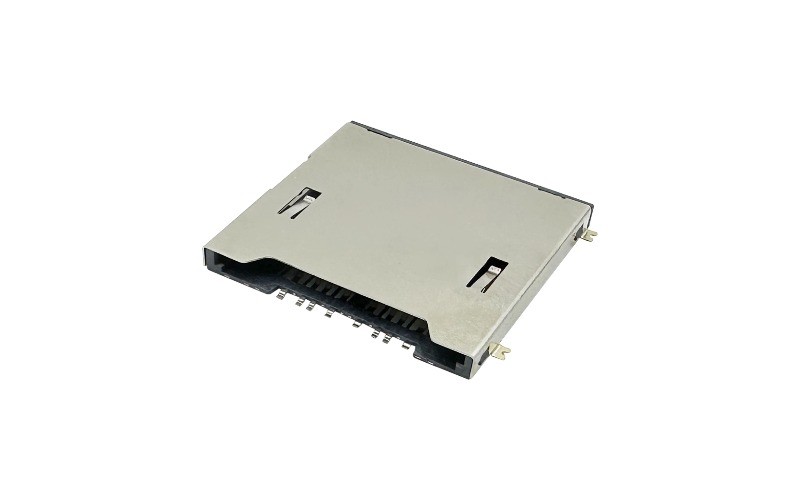
In modern automotive electronics, the humble SD Card Connector has become a critical component behind infotainment systems, dash cameras, ADAS modules, telematics devices, navigation systems, and edge AI data logging platforms.
However, many engineers still underestimate one key reality:
Automotive SD card connectors are not failing because of temperature alone.
In real vehicle environments, connector reliability is challenged by a combination of vibration, thermal cycling, mechanical shock, humidity, dust contamination, electromagnetic interference (EMI), long-term insertion wear, and signal integrity degradation.
For automotive engineers, selecting the wrong SD Card Connector can result in intermittent contact failures, corrupted storage data, unstable firmware updates, infotainment crashes, dashcam recording interruption, and long-term field reliability issues.
This is why automotive-grade connector selection must go far beyond simply checking the temperature specification.
Why Automotive Environments Are Extremely Harsh for SD Card Connectors
Unlike consumer electronics, vehicle electronics operate under constant environmental stress.
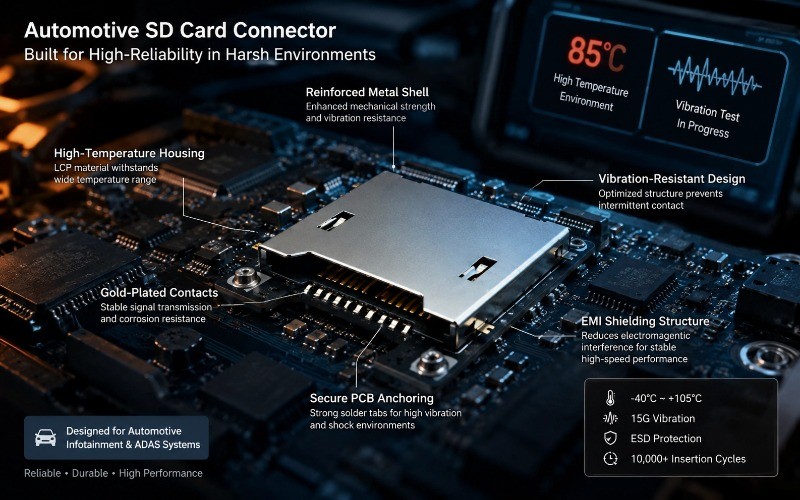
A dashboard camera installed inside a parked vehicle during summer may experience temperatures exceeding 85°C. Meanwhile, road vibration continuously applies micro-motion stress to the connector contacts.
Over time, this combination creates fretting corrosion, contact oxidation, terminal deformation, unstable contact resistance, and intermittent signal interruption.
Research on automotive connector failures shows that combined thermal and vibration stress significantly accelerates contact degradation and increases resistance instability.
High Temperature Resistance Alone Is Not Enough
Many SD Card Connector suppliers advertise:
“High-temp resistant”
“105°C capable”
“Industrial-grade materials”
But temperature resistance alone does not guarantee automotive reliability.
The real engineering challenge is maintaining stable mechanical contact under dynamic stress.
Inside vehicles:
vibration never stops
thermal expansion continuously changes contact geometry
humidity accelerates oxidation
EMI affects high-speed data transmission
An SD Card Connector may survive temperature testing while still failing during long-term vibration cycles.
This is why automotive engineers increasingly focus on:
contact stability
shell reinforcement
terminal elasticity
insertion durability
anti-vibration structure
shielding effectiveness
rather than temperature ratings alone.
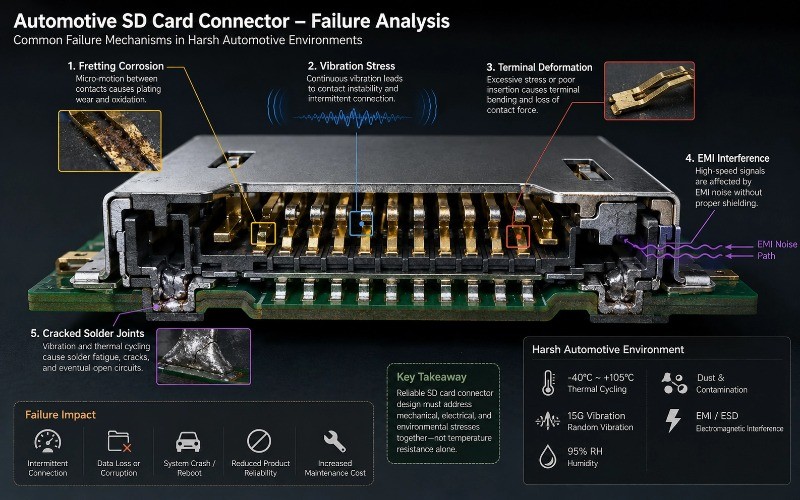
The 5 Hidden Failure Mechanisms Engineers Commonly Overlook
1. Fretting Corrosion Under Vibration
Tiny repetitive movements between contacts gradually remove plating surfaces.
This creates oxidation, unstable resistance, and intermittent data transfer.
This issue becomes especially dangerous in dash cameras, vehicle data loggers, and ADAS recording systems where uninterrupted storage reliability is essential.
2. Contact Force Degradation
Poor terminal material selection can reduce spring elasticity over time.
As thermal cycling continues:
insertion force weakens
contact pressure drops
signal stability becomes inconsistent
3. Weak PCB Retention Structure
In many low-cost connectors, the shell anchoring design is insufficient for automotive vibration environments.
This can lead to solder cracking, pad lifting, and connector shifting.
4. EMI & High-Speed Signal Instability
Modern SD interfaces support increasingly high data rates.
Without proper shielding:
EMI noise increases
signal reflections worsen
data corruption risk rises
especially near automotive power systems.
5. Mechanical Wear From Long-Term Usage
Vehicle systems often remain operational for years.
Low-quality connectors may experience:
terminal wear
insertion fatigue
locking instability
poor card retention
after repeated service cycles.
What Automotive Engineers Should Really Verify
Mechanical Reliability
Key questions include:
Is the shell reinforced?
Are the solder tabs large enough?
Is the card retention force stable?
Is the insertion mechanism vibration-resistant?
Can the connector survive long-term mechanical cycling?
At MOARCONN, automotive-oriented SD card connector solutions are developed with reinforced shell structures and optimized retention designs specifically for harsh environments.
Material Selection
Automotive-grade SD connectors typically require:
High-temperature LCP housing
Stainless steel shielding shell
High-elasticity phosphor bronze terminals
Thick gold plating on contact areas
Material quality directly affects long-term contact reliability.
Signal Integrity Performance
As automotive systems evolve toward:
AI edge computing
multi-camera systems
HD recording
high-speed diagnostics
connector SI performance becomes increasingly important.
Engineers should evaluate:
impedance continuity
contact resistance stability
shielding structure
grounding path quality
Durability Validation
Reliable automotive SD Card Connectors should pass:
thermal cycling test
random vibration test
mechanical shock test
insertion/extraction lifecycle testing
humidity resistance testing
These tests help simulate real automotive operating environments.
Why Many Automotive OEMs Prefer Custom SD Card Connectors
In automotive projects, standard catalog parts often cannot fully match:
PCB space constraints
enclosure structure
vibration requirements
insertion direction
thermal management layout
This is why many OEM and Tier-1 suppliers increasingly adopt customized connector solutions.
MOARCONN supports customized SD Card Connector development including:
custom shell reinforcement
optimized mounting tabs
push-pull or hinged structures
customized plating thickness
low-profile layouts
enhanced EMI shielding
application-specific retention force
Engineer’s PCB Design Recommendations
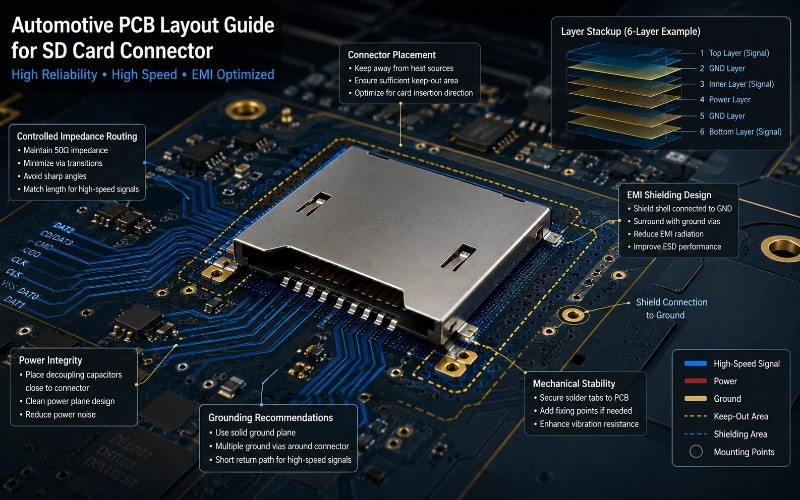
Maintain Proper Grounding Paths
Poor grounding increases EMI susceptibility.
Recommended practices:
solid ground reference
short return paths
shielding continuity
Reduce Mechanical Stress Near Connector Area
Avoid placing:
large components
screw mounting points
board cutouts
too close to the connector footprint.
Optimize High-Speed Routing
For high-speed SD interfaces:
minimize via transitions
maintain impedance consistency
avoid sharp routing angles
isolate noisy power traces
Add Structural Reinforcement If Necessary
For severe vibration applications:
underfill
bracket support
reinforced mounting
may improve long-term durability.
Why Reliability Engineering Matters More Than Ever
As vehicles become smarter and increasingly software-driven, storage reliability is no longer a secondary consideration.
A failed SD Card Connector may now affect:
autonomous driving data
firmware updates
infotainment systems
edge AI logging
fleet management systems
In automotive electronics, connectors are no longer passive components.
They are part of the system reliability architecture itself.
About MOARCONN
MOARCONN is a professional manufacturer specializing in:
SD Card Connectors
Micro SD Connectors
SIM Card Connectors
Smart Card Connectors
With over 20 years of connector manufacturing experience, MOARCONN provides:
customized connector development
precision mold design
rapid prototyping
automotive & industrial connector solutions
reliability-focused manufacturing
Final Thoughts
Selecting an automotive SD Card Connector is not simply about finding a component that survives high temperature.
True automotive reliability requires balancing:
vibration resistance
contact stability
EMI performance
insertion durability
mechanical reinforcement
long-term signal integrity
For engineers designing next-generation automotive electronics, connector selection should be treated as a system-level reliability decision — not just a purchasing task.