Push-Push vs Push-Pull vs Hinge Type Micro SD Card Connectors: Which Design Is Better
- Share
- publisher
- MOARCONN
- Issue Time
- Jul 8,2026
Summary
Explore Moarconn Micro SD Card Connectors and compare Push-Push, Push-Pull, and Hinge designs for reliable electronic applications.
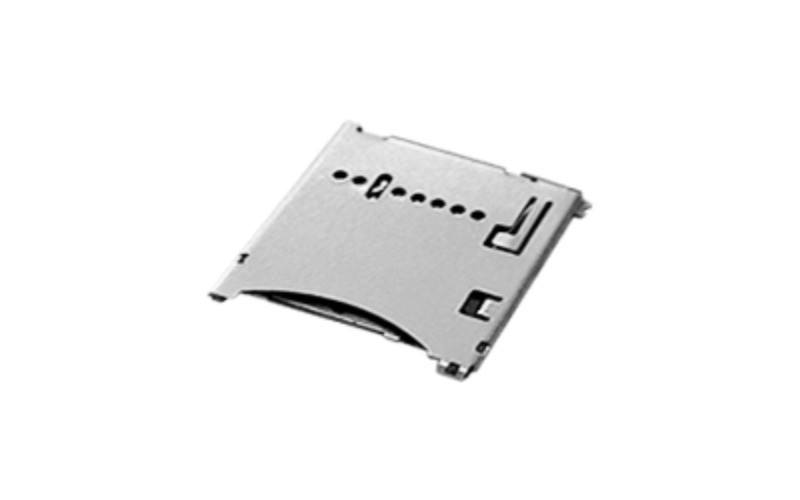
Push-Push vs Push-Pull vs Hinge Type Micro SD Card Connectors: Which Design Is Better?
An Engineer’s Guide to Choosing the Right Micro SD Card Connector
In modern electronic devices, Micro SD Card Connectors play a critical role in providing reliable storage expansion and data access.
From consumer electronics to industrial embedded systems, the connector is not only a mechanical interface but also an important component that affects:
Data transmission stability
Card retention reliability
Product lifetime
User experience
Manufacturing cost
When selecting a Micro SD Card Connector, engineers often need to choose between three common mechanical designs:
Push-Push Type
Push-Pull Type
Hinge Type
Each design has different advantages depending on application requirements.
This guide explains the differences between these three Micro SD Card Connector mechanisms and provides practical recommendations for hardware designers.
1. What Is a Micro SD Card Connector?
A Micro SD Card Connector is a precision electronic component that creates both mechanical and electrical connections between a Micro SD memory card and the PCB of an electronic device.
The connector contains:
Electrical Contact Terminals
The metal contacts provide signal transmission between:
Micro SD card
Host controller
PCB circuit
Card Retention Mechanism
The mechanical structure ensures that the card remains securely positioned during operation.
Detection Switch
Many Micro SD connectors include a card detection switch to identify insertion status.
Housing Structure
The plastic housing maintains:
Card alignment
Mechanical protection
Connector durability
For engineers, choosing the correct connector design is essential because mechanical failure can directly affect device reliability.
2. Why Micro SD Card Connector Design Matters
Different applications require different connector characteristics.
For example:
A digital camera may require:
Frequent card replacement
Better user experience
Easy insertion/removal
An industrial controller may require:
Strong vibration resistance
Long service life
Secure card locking
Therefore, selecting the correct Micro SD Card Connector mechanism should consider:
Design Factor Engineering Consideration
Insertion Frequency How often users replace cards
Mechanical Stress Shock and vibration environment
PCB Space Available mounting area
Product Lifetime Required durability
Cost Manufacturing budget
3. Push-Push Micro SD Card Connector
How Push-Push Mechanism Works
The Push-Push Micro SD Connector uses an internal spring and locking mechanism.
Operation:
Insert the Micro SD card
Internal latch locks the card
Press again
Spring mechanism releases the card
This mechanism provides a simple user experience similar to many consumer devices.
Advantages of Push-Push Micro SD Connector
1. Excellent User Experience
Users can easily:
Insert cards
Remove cards
Replace storage media
2. Compact Product Integration
Push-Push connectors are widely used where space efficiency is important.
Common applications:
Digital cameras
Portable devices
Smart devices
Automotive electronics
3. Easy Card Access
Suitable for products where users frequently exchange memory cards.
Limitations of Push-Push Design
Because Push-Push connectors contain more mechanical parts:
Potential considerations:
Spring fatigue after long-term use
More complex structure
Higher manufacturing requirements
For high-cycle applications, engineers should carefully evaluate insertion life.
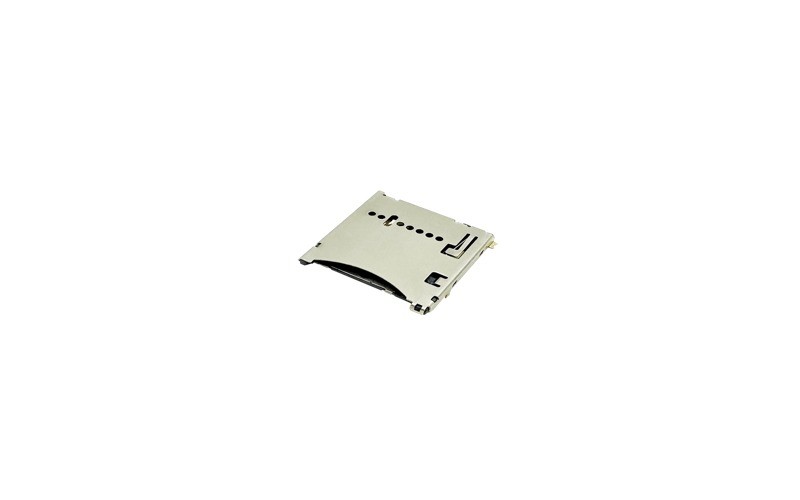
4. Push-Pull Micro SD Card Connector
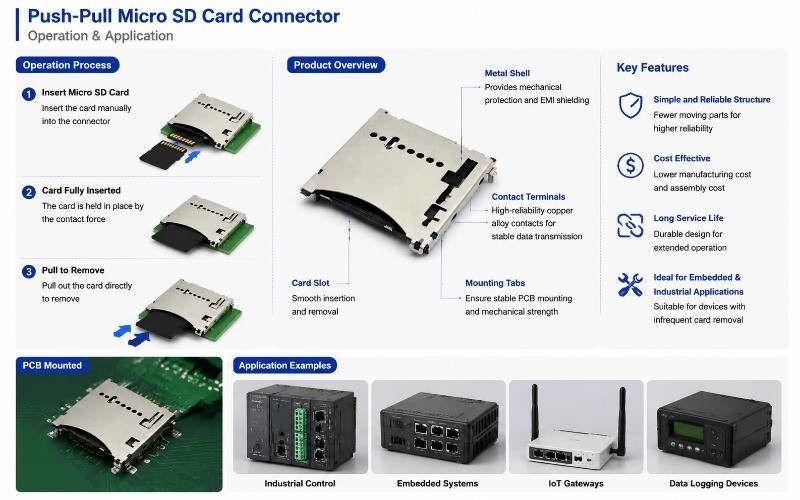
How Push-Pull Mechanism Works
Push-Pull connectors use a simpler mechanical structure.
Operation:
Insert the Micro SD card manually
Connector holds the card through contact force
Pull the card directly to remove
Advantages of Push-Pull Micro SD Connector
1. Simple and Reliable Structure
Compared with Push-Push designs:
Fewer moving parts
Lower mechanical complexity
Reliable long-term operation
2. Cost Effective
Push-Pull connectors are often preferred for:
Embedded systems
Industrial electronics
Devices requiring low maintenance
3. Strong Mechanical Reliability
Suitable for applications where users rarely remove the card.
Limitations
Possible disadvantages:
Less convenient user operation
Requires physical access for removal
Not ideal for frequent card exchange
Typical Applications
Push-Pull Micro SD connectors are commonly used in:
Industrial controllers
Embedded computers
IoT gateways
Data logging equipment
5. Hinge Type Micro SD Card Connector
How Hinge Type Works
Hinge Type connectors use a flip-cover locking mechanism.
The Micro SD card is placed into the connector and secured by closing the hinged cover.
Advantages of Hinge Type Connector
1. Excellent Card Retention
The locking cover provides:
Strong mechanical holding force
Better vibration resistance
2. Suitable for Harsh Environments
Recommended for:
Industrial equipment
Outdoor devices
Automotive systems
3. High Reliability
The design reduces accidental card movement during operation.
Limitations
Considerations:
Requires additional PCB space
Slightly more complex assembly
Typical Applications
Examples:
Industrial computers
Vehicle monitoring systems
Data acquisition equipment
Outdoor IoT devices
6. Push-Push vs Push-Pull vs Hinge Type Comparison
Feature Push-Push Push-Pull Hinge
User Operation Excellent Moderate Moderate
Mechanical Complexity High Low Medium
Cost Medium Low Medium
Card Retention Good Good Excellent
Vibration Resistance Medium Medium High
Frequent Access Excellent Moderate Low
Industrial Usage Medium High Excellent
7. How Engineers Choose the Right Micro SD Card Connector?
7. How Engineers Choose the Right Micro SD Card Connector?
A practical selection guide:
Choose Push-Push When:
✔ Users frequently remove cards
✔ Consumer-friendly operation is required
✔ Space saving is important
Examples:
Cameras
Smart devices
Portable electronics
Choose Push-Pull When:
✔ Reliability is more important than user experience
✔ Cost optimization is required
✔ Card replacement is occasional
Examples:
Industrial controllers
Embedded products
Choose Hinge Type When:
✔ Strong mechanical retention is required
✔ Device operates under vibration
✔ Long-term reliability is critical
Examples:
Automotive
Industrial monitoring
Outdoor equipment
8. PCB Design Considerations for Micro SD Card Connectors
Selecting the connector is only the first step.
Engineers should also consider:
PCB Layout
Important factors:
Correct footprint design
Signal trace length
Grounding design
EMI control
Mechanical Support
Consider:
Connector mounting strength
Solder joint reliability
Card insertion force
Thermal Environment
Evaluate:
Operating temperature
Material stability
Contact reliability
9. Moarconn Micro SD Card Connector Solutions
As a professional card connector manufacturer, Moarconn focuses on providing reliable and customizable Micro SD Card Connector solutions for global electronic manufacturers.
Moarconn Micro SD Card Connector products support different mechanical designs including:
Push-Push
Push-Pull
Hinged structures
and offer customization options based on:
Connector height
Mounting direction
Material selection
Contact plating
Mechanical structure
Moarconn solutions are designed for applications including:
Consumer electronics
Automotive electronics
Industrial equipment
IoT devices
Data storage systems
Why Engineers Choose Moarconn
1. Custom Engineering Support
Moarconn provides customized connector solutions according to customer requirements, including:
Mechanical modification
PCB compatibility
Special structural designs
2. Reliable Manufacturing Capability
Key manufacturing considerations include:
Precision stamping
Plastic injection molding
Contact plating
Assembly inspection
3. Wide Product Selection
Moarconn provides Micro SD Card Connector solutions with different:
Heights
Mounting styles
Connector mechanisms
10. Final Conclusion: Which Micro SD Card Connector Design Is Better?
The correct choice depends on:
Application environment
User interaction frequency
Reliability requirements
Cost target
Mechanical constraints
General recommendation:
Application Recommended Connector
Consumer electronics Push-Push
Embedded devices Push-Pull
Industrial & automotive Hinge Type
For engineers developing new products, selecting the right Micro SD Card Connector early in the design stage can significantly improve product reliability and reduce future redesign costs.
Moarconn provides engineering support and customized Micro SD Card Connector solutions to help customers select the right connector design for their applications.