SD Card Connector Applications: From Consumer Electronics to Industrial Use
- Share
- publisher
- MOARCONN
- Issue Time
- Aug 8,2025
Summary
SD card connectors have become an essential interface in modern electronics, enabling secure, removable data storage across various devices.
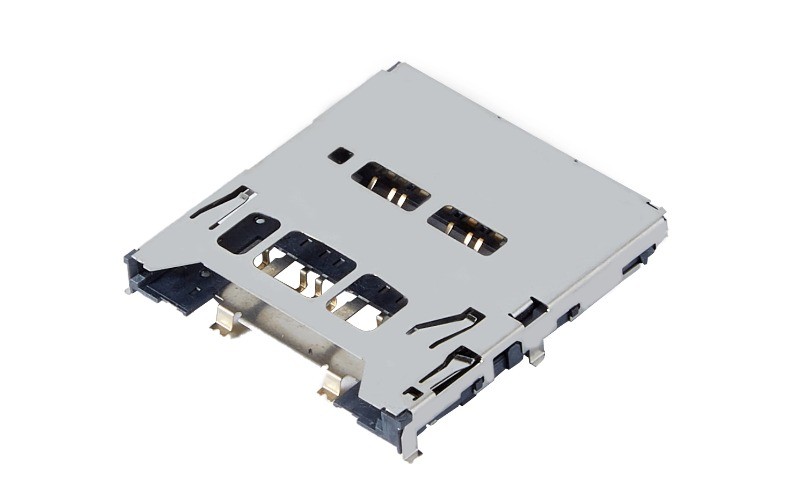
1. Consumer Electronics: Powering Portability and Performance
2. Automotive Electronics: Reliable Storage in Tough Environments
3. Industrial and Embedded Systems: Endurance Meets Functionality
4. Medical Devices and IoT: Compact and Secure Interfaces
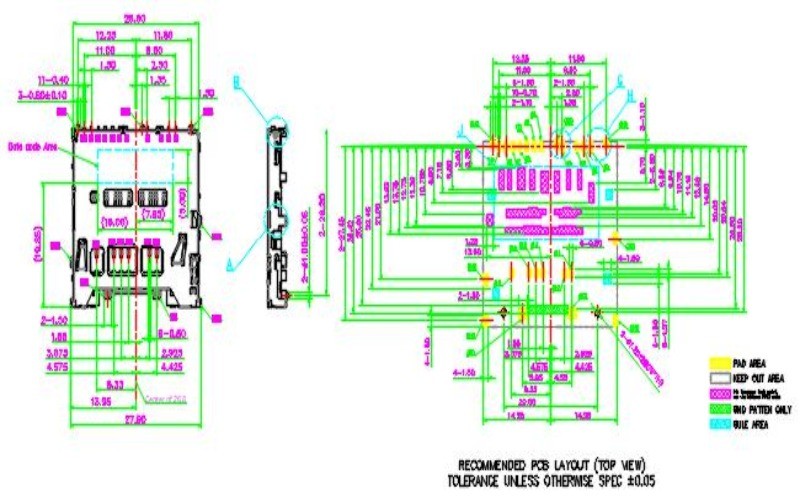
Application Requirement Matrix
The same connector family is sold into five industries that ask completely different things of it. Before specifying a part, put the application in this table and see which column actually binds.
| Application | Typical card | Height / mechanism | Temperature | The specification that decides the design |
|---|---|---|---|---|
| Smartphones, tablets, wearables | microSD | 1.28 to 1.60mm, push-push or tray | -20 to 70°C | Height and insertion feel; the card is rarely the data path |
| Automotive infotainment, dash cam, telematics | SD or microSD | 2.94 to 3.58mm, push-push or hinge | -40 to 85°C | Vibration and thermal cycling, not speed |
| Industrial control, data logger, gateway | microSD or SD | Any; hinge preferred | -40 to 85°C | Cycle life and contact resistance stability over years |
| Medical diagnostics, patient monitor | microSD | 1.5 to 1.8mm, hinge or push-pull | -20 to 70°C | Card retention and cleanability of the housing |
| Drone, body camera, surveillance | microSD | 1.28 to 1.5mm, push-push | -20 to 80°C | Sustained write throughput and shock resistance |
Reading down the last column is the useful part. Consumer products fail on height; automotive and industrial products fail on contact stability after temperature and vibration; imaging products fail on sustained write performance. A connector that is excellent for one of those three is not automatically good for the others, which is why "which industry is this for" is the first question in any RFQ.
What Each Industry Actually Tests For
Consumer electronics tests the drop and the pocket. A phone that lands on a corner transmits a shock through the housing into the socket, and the failure is not usually a broken contact — it is a card that has walked 0.4mm out of the slot and lost DAT lines. Card retention under shock, not insertion force, is the real specification. The other consumer requirement is cosmetic: the slot must feel consistent from the first insertion to the thousandth, which is a force-window question rather than a materials one.
Automotive tests time at temperature. A dash camera cycles from -30°C overnight to 70°C behind a windscreen every day for years, and the connector sees that thermal excursion as repeated differential expansion between terminal and housing. Ask for ISO 16750-3 vibration evidence and for contact resistance measured after thermal cycling, not just at room temperature. MOARCONN rates -45°C to 80°C with 30mΩ or less across that range, which is the number that survives this test.
Industrial and embedded tests cycle life against the calendar. A data logger in a substation may be read once a month for fifteen years — only 180 insertions, but 15 years of humidity and temperature. Plating thickness decides the outcome: at 0.025µm gold over nickel on phosphor bronze the barrier layer stays covered, and contact resistance holds at 30mΩ or less through a 10,000-cycle rating. At half that plating the part passes incoming inspection and drifts in year three.
Medical and IoT tests retention and cleanliness. Diagnostic devices are wiped down, sometimes with aggressive agents, and a hinge or push-pull mechanism with exposed contacts is easier to clean than a push-push ejector with a heart-shaped cam inside it. Sealed IoT devices increasingly skip the socket entirely for a soldered MFF2 SIM, but where removable storage is required for logs, a microSD hinge socket with a defined retention force is the practical answer.
Consumer-Grade vs Industrial-Grade: What the Price Difference Buys
Two connectors can look identical on a drawing and differ by a factor of two in price. The difference is usually in four places, and only one of them is visible.
- Plating thickness. 0.025µm gold over nickel versus a flash of gold over bare copper. Visible only on the plating report; it is the single largest driver of long-term contact resistance.
- Terminal material and force. Phosphor bronze with a controlled normal force holds contact pressure through thermal cycling. Thinner stock relaxes and loses force, which shows up as intermittent detection, not as an open circuit.
- Coplanarity tolerance. ±0.05mm versus ±0.10mm. This is a stamping and assembly discipline, and it decides first-pass yield on thin boards.
- Traceability. Whether the supplier can tie a returned part to a production lot. Three years of sample retention is what makes that possible.
For a product with a two-year replacement cycle and a retail return channel, a consumer-grade part is a rational choice. For a device that is installed once and serviced on a five-year contract, the industrial-grade part is cheaper over the contract life even at twice the unit price — the field visit costs more than the connector by an order of magnitude.
SD Socket vs Soldered Flash: When Not to Use a Connector
A card socket is not always the right answer, and saying so is part of specifying honestly. The socket wins when storage must be removable, when capacity is decided at deployment, or when the data has to leave the device physically — video from a dash cam, logs from a meter, images from a diagnostic device. Those are all cases where the card itself is the deliverable.
Soldered eMMC or NAND wins when the device is sealed, when capacity is fixed at manufacture, and when a mechanical failure mode is unacceptable. It removes the socket, the card, the retention spring and roughly 3mm of height, and it eliminates the single most common field failure in rugged products. The trade is that firmware update, log extraction and warranty replacement all move to a wired or wireless path.
Many industrial designs hedge: a soldered flash for the operating system and a microSD socket for user data or field logs. That combination gets the reliability of embedded storage with the serviceability of removable media, at the cost of an extra interface and a slightly larger board. If you take that route, specify the socket for the lower duty cycle it will actually see — a few hundred insertions over the product life — and spend the budget on plating and retention instead of cycle count.
SD Card Connector Application FAQ
Which connector height should a dash camera use?
Full-size SD at 2.94mm push-pull or 3.58mm push-push is the usual choice because the card is large enough to handle with gloves and the housing has room. A microSD push-push at 1.5mm to 1.6mm is the alternative for compact units. What matters more than height is retention under shock and a temperature rating that covers a windscreen in summer — specify -40°C to 85°C and ask for ISO 16750-3 vibration evidence.
Can I use a consumer microSD socket in an industrial gateway?
Mechanically yes, and it will pass the prototype. The risk is plating thickness and contact force, which decide whether contact resistance still holds at 30mΩ after five years of humidity and a few hundred insertions. If the gateway is on a service contract, specify 0.025µm gold minimum, ask for the force curve, and treat the price difference as insurance rather than cost.
Why does a medical device prefer a hinge socket?
Because it can be cleaned. A hinge or flip-lock socket exposes the contact area, has no internal ejector mechanism to trap residue, and gives a visible confirmation that the card is latched. Push-push ejectors have a cam and a spring inside the housing, which is exactly where cleaning agents and debris accumulate.
Do SD Express cards need a different connector?
Yes. SD Express uses a second row of contacts for PCIe lanes, so the socket must have that second row and the PCB must route a controlled-impedance pair to it. A UHS-I socket will accept an SD Express card physically in some cases but will fall back to the slower legacy mode. Decide the interface before the layout — retrofitting the second row is a board respin.
5. Why Choose MOARCONN SD Card Connectors?
Conclusion
MOARCONN Quality Anchors
Every MOARCONN card socket connector is validated to 10,000 mating cycles (tested to GB/T 5095.7-1997; over 2× the 3,000–5,000 cycles common in the industry), operates from -45°C to 80°C, and ships with contact resistance ≤30mΩ thanks to ≥0.025µm gold-plated phosphor-bronze terminals. IATF 16949 certified production supports 0 MOQ orders with 7-day sampling and a 25-day development cycle — backed by in-house mold, stamping and injection molding factories and 32 granted patents.