SD Card Connector Reliability: Push-Push Mechanisms, Contact Design, and Durability
- Share
- publisher
- MOARCONN
- Issue Time
- Sep 18,2026
Summary
Explore SD Card Connector reliability, push-push mechanisms, contact design, durability, mating cycles, and testing
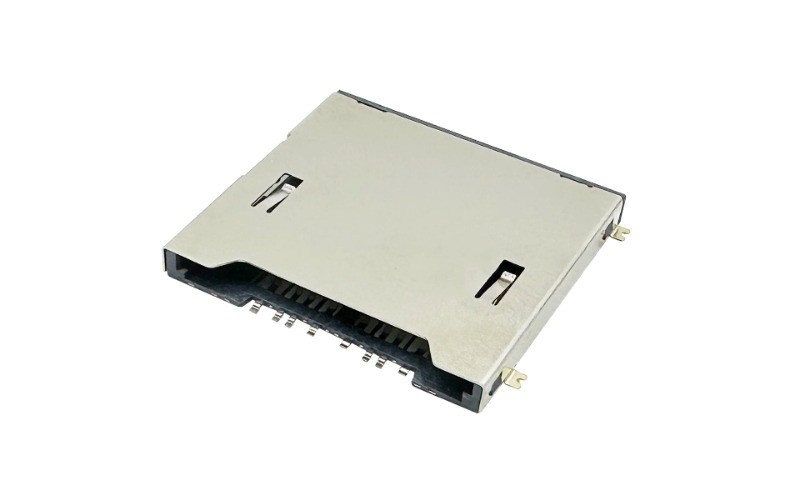
SD Card Connector Reliability: Push-Push Mechanisms, Contact Design, and Durability
And SD Card Connector is more than a socket for a memory card. It must provide stable electrical contact, reliable card retention, and consistent insertion and ejection throughout the product's service life.
For hardware engineers, connector reliability depends on several factors, including push-push mechanism design, contact force, contact resistance, materials, mating cycles, and environmental performance.
This guide explains the key factors to consider when selecting a reliable SD Card Connector.
1. What Makes an SD Card Connector Reliable?
SD Card Connector reliability can be evaluated from three perspectives:
Mechanical reliability:insertion, ejection, card retention, and mating cycles
Electrical reliability:contact force, contact resistance, and signal continuity
Environmental reliability:temperature, humidity, vibration, shock, and contamination
A reliable connector should maintain stable performance throughout the expected lifetime of the product.
Engineer's Note:Mating-cycle rating is important, but it should never be the only reliability specification you evaluate.
2. Push-Push Mechanism and Mechanical Durability
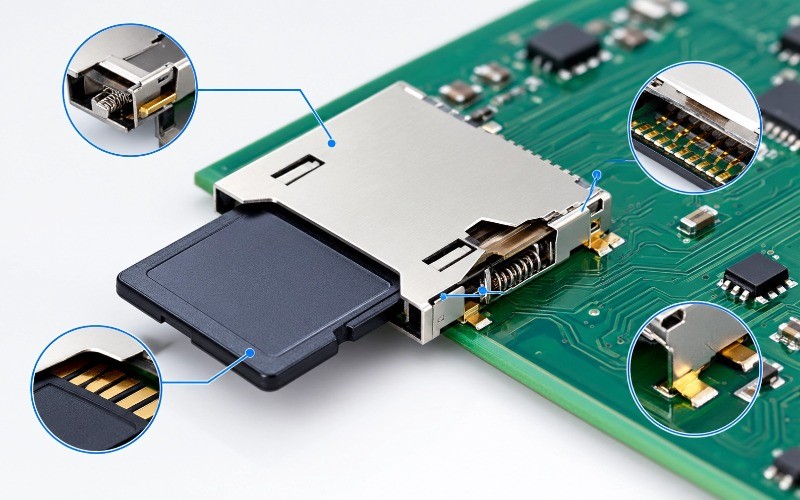
The push-push SD Card Connector is widely used because it allows the user to insert and eject the card without pulling it directly from the socket.
The basic operation is:
Insert → Lock → Push Again → Eject
For engineers, important mechanical parameters include:
Insertion force
Ejection force
Card retention force
Locking consistency
Spring performance
Mechanism wear
Housing strength
A well-designed mechanism should maintain consistent operation after repeated insertion and removal.
For products with frequent card access, engineers should select a connector with a mating-cycle rating appropriate for the expected product lifetime.
3. Contact Design and Contact Resistance
Mechanical durability is only one part of SD Card Connector reliability.
The electrical contacts must maintain stable contact with the SD card pads over thousands of mating cycles.
Important factors include:
Contact geometry
Contact force
Contact material
Contact plating
Contact wipe
Manufacturing tolerances
Why Contact Resistance Matters
Contact resistance can increase because of:
Contact wear
Contamination
Oxidation
Plating damage
Reduced contact force
Therefore, engineers should evaluate not only the initial contact resistance, but also how it changes after mechanical and environmental testing.
The goal is a contact system that provides stable electrical continuity while maintaining reasonable insertion force and wear resistance.
4. Contact Materials and Plating
Common SD Card Connector contact materials include copper alloys or phosphor bronze, while contact areas may use gold plating.
Material selection affects:
Electrical conductivity
Spring characteristics
Wear resistance
Corrosion resistance
Long-term contact stability
Gold plating can help protect contact surfaces from oxidation, but plating alone does not determine reliability.
A reliable contact system depends on:
Material + Contact Geometry + Contact Force + Plating + Manufacturing Precision
5. How Many Mating Cycles Do You Need?
SD Card Connector durability is commonly specified by the number of mating cycles, such as 5,000 or 10,000 cycles.
The correct rating depends on actual product usage.
For example, if an industrial device requires approximately 1,000 card changes during its service life, a connector rated for 5,000 cycles may provide an appropriate design margin.
For frequently serviced equipment, a higher-cycle connector may be more appropriate.
Engineer's Tip: Calculate the expected number of card insertions and removals over the product lifetime before selecting the connector.
6. Environmental Reliability
SD Card Connectors used in industrial or automotive equipment may experience:
Temperature cycling
Humidity
Vibration
Mechanical shock
Dust and contamination
These conditions can affect contact resistance, card retention, mechanical components, and solder joints.
For demanding applications, engineers should therefore review:
Operating temperature
Humidity resistance
Vibration performance
Shock resistance
Corrosion resistance
The connector should be qualified under conditions that represent the actual application environment.
7. Common SD Card Connector Failure Modes
Understanding potential failure modes can help engineers select the right connector.
| Failure Mode | Possible Cause |
Intermittent contact | Contact wear, contamination, insufficient force |
| Increasing contact resistance | Wear, oxidation, plating damage |
| Card does not eject | Mechanism wear or spring failure |
| Card does not lock | Misalignment or mechanical deformation |
Connector damage | Excessive force or mechanical shock |
Solder joint failure | PCB flex, vibration, or mechanical stress |
Testing should focus on the failure modes most relevant to the final product.
8. How to Test an SD Card Connector
A practical reliability evaluation may include:
Mechanical Endurance
Test insertion and ejection over the required number of cycles.
Contact Resistance
Measure initial resistance and resistance after endurance testing.
Temperature and Humidity
Evaluate performance under the application's environmental conditions.
Vibration and Shock
Test the connector and PCB assembly under expected mechanical stresses.
Visual Inspection
Check terminals, housing, springs, locking mechanisms, and solder joints for deformation or damage.

9. MOARCONN: SD Card Connector Engineering and Customization
At MOARCONN, SD Card Connector reliability is considered from both the component and application perspectives.
With more than 20 years of experience in card connector development and manufacturing, MOARCONN provides SD, Micro SD, SIM, and smart card connector solutions.
Our capabilities cover:
Product design
Precision tooling
Connector manufacturing
Sample development
ODM customization
Trial production
Mass production
MOARCONN has also developed more than 1,200 unique connector products, supporting customers with application-specific connector requirements.
For projects requiring special connector height, mounting configuration, card retention, durability, or other customized specifications, an application-specific SD Card Connector can be developed instead of relying only on standard components.
10. SD Card Connector Selection Checklist
Before selecting an SD Card Connector, engineers should confirm:
SD card type
Connector dimensions
Mounting direction
Push-push or other mechanism
Required mating cycles
Contact resistance
Contact material and plating
Card retention
Operating temperature
Vibration and shock requirements
PCB footprint
Customization requirements
A connector should be selected based on the complete application—not just price or dimensions.
Frequently Asked Questions
What makes an SD Card Connector reliable?
Reliable performance depends on mechanical design, contact force, contact materials, plating, mating-cycle capability, card retention, PCB integration, and environmental resistance.
Is a push-push SD Card Connector reliable?
Yes, when properly designed and qualified. Its reliability depends on the locking mechanism, spring system, housing, contact design, and required operating cycles.
How many cycles should an SD Card Connector support?
The required number depends on how frequently the card will be inserted and removed during the product's service life. Common connector specifications include 5,000 and 10,000 cycles.
Does gold plating improve connector reliability?
Gold plating can improve resistance to oxidation and support stable electrical contact, but overall reliability also depends on contact geometry, force, material, and manufacturing quality.
Can MOARCONN customize SD Card Connectors?
Yes. MOARCONN provides ODM and customized connector development from initial design and tooling through sampling and mass production.
Conclusion
A reliable SD Card Connector requires more than a suitable footprint.
Engineers should evaluate the complete system:
Push-Push Mechanism → Contact Design → Contact Resistance → Mating Cycles → Materials → Environmental Conditions → PCB Integration
By considering these factors during the design stage, engineers can reduce the risk of intermittent contact, mechanical failure, and premature connector wear.
For standard or customized SD Card Connector requirements, MOARCONN can support your project from connector design and tooling to production.
Contact MOARCONN to discuss your SD Card Connector requirements.