SD Card Connectors in 5G Edge Devices: Signal Integrity Bottlenecks and Engineering Solutions
- Share
- publisher
- MOARCONN
- Issue Time
- Apr 16,2026
Summary
Explore how SD card connectors impact signal integrity in 5G edge devices, key bottlenecks, and engineering solutions from MOARCONN.
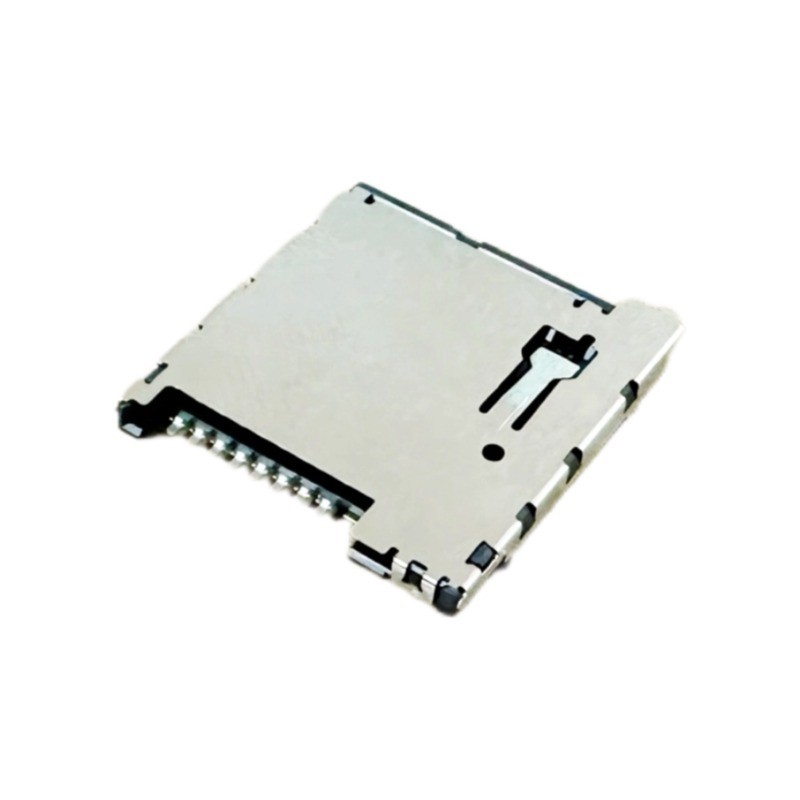
Introduction
In the era of 5G and edge computing, data is no longer stored passively—it is processed, transmitted, and analyzed in real time.
Yet many engineers overlook a critical component:
The SD card connector.
In high-speed systems, SD card connectors are no longer passive mechanical interfaces—they are part of the high-frequency signal channel. Poor design can lead to data corruption, system instability, and performance degradation.
This article explores:
Why SD card connectors become bottlenecks in 5G edge devices
Key signal integrity challenges
Engineering solutions across connector, PCB, and system levels
How MOARCONN addresses these challenges
Why 5G Edge Devices Redefine SD Card Connector Requirements
5G edge devices—such as AI cameras, industrial gateways, and smart terminals—require:
Ultra-low latency
High data throughput
Continuous real-time storage
Meanwhile, SD interfaces are evolving:
UHS-I → UHS-II → SD Express
Integration of PCIe / NVMe protocols
This means SD card connectors must now support high-frequency signal transmission rather than simple electrical contact.
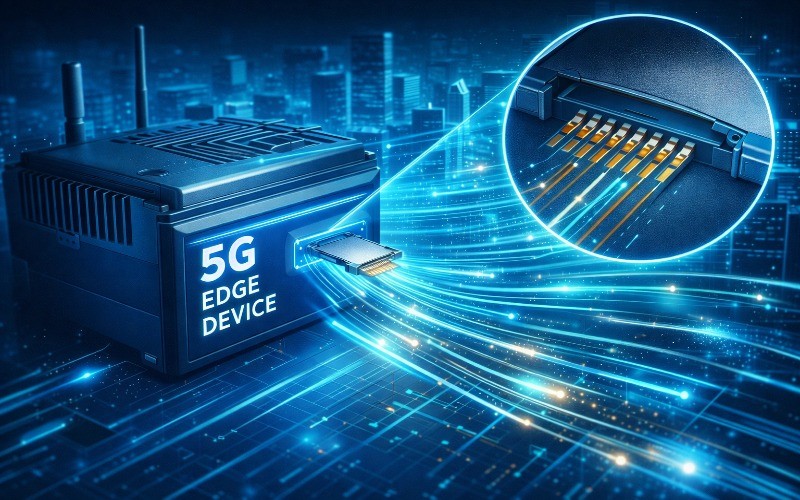
Signal Integrity Bottlenecks
SD Connectors as Signal Channels
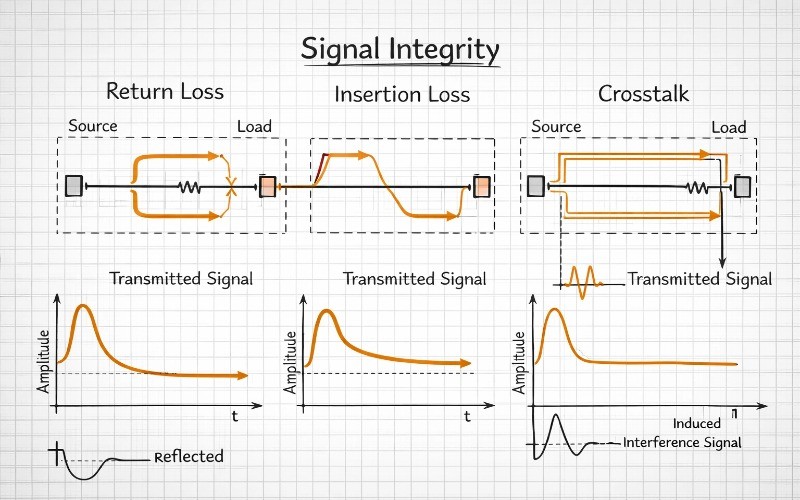
At high speeds, even minor discontinuities can cause:
Signal reflection
Transmission loss
Data instability
Three Key Challenges
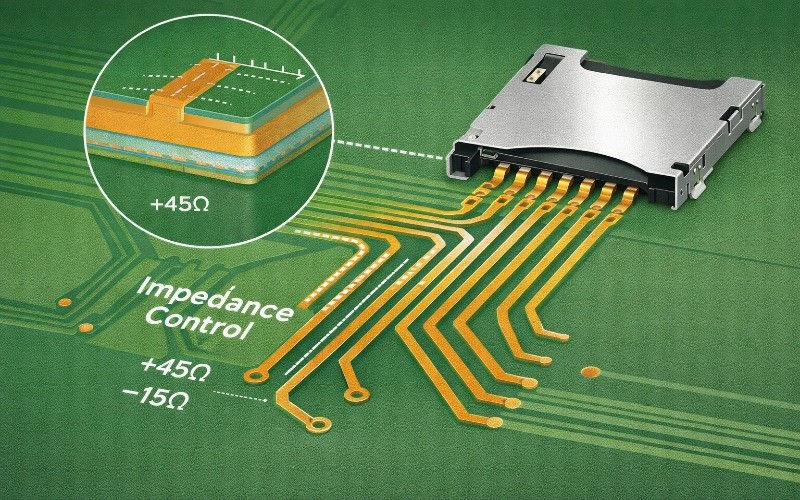
1. Impedance Mismatch
Ideal impedance: 50Ω
Connector transitions often break impedance continuity
Result: Return loss and signal reflection
2. Insertion Loss
Signal attenuation increases with frequency
Influenced by materials and structure
Result: Reduced signal strength
3. Crosstalk and EMI
High-density pin layouts increase interference
5G RF environments worsen noise
Result: Data errors and unstable communication
Connector Design Challenges
Modern SD connectors must balance:
Miniaturization
High-speed transmission
Mechanical durability
Backward compatibility
SD Express introduces:
Additional high-speed pins
PCIe-level performance requirements
Increased EMC and thermal challenges
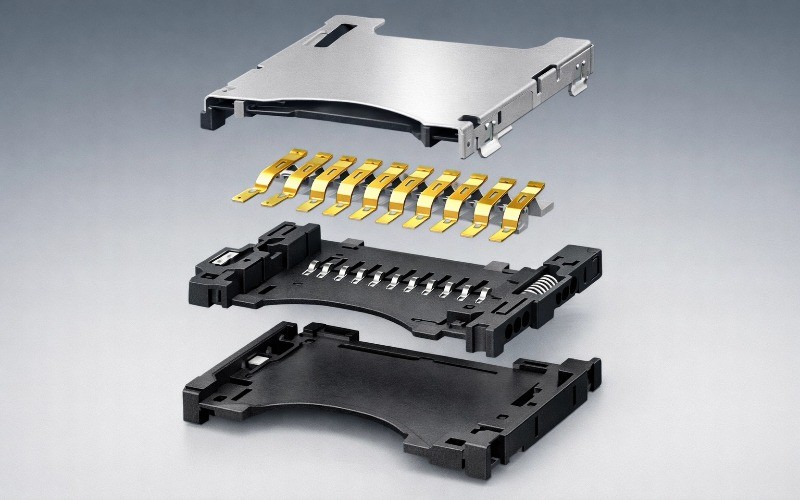
Engineering Solutions
Connector-Level Optimization
Optimized pin layout to reduce crosstalk
Gold plating for stable conductivity
Precision geometry for impedance control
PCB Layout Best Practices
Maintain 50Ω impedance
Match trace lengths
Minimize vias and stubs
Use solid ground planes
System-Level Optimization
EMI shielding
Thermal design
Strategic connector placement
MOARCONN Engineering Approach
At MOARCONN, SD card connectors are treated as critical signal interfaces.
Our capabilities include:
High-Speed SI Design
Impedance-controlled terminals
Low insertion loss materials
Crosstalk-optimized structures
Integrated Manufacturing
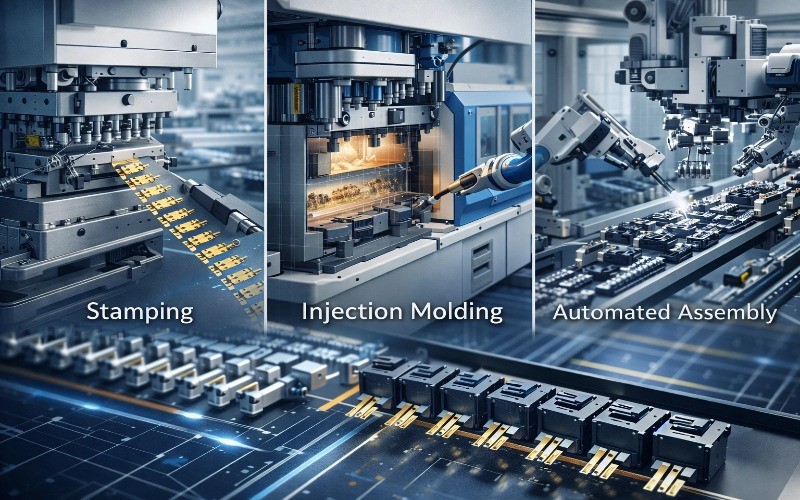
In-house stamping, molding, and assembly
Tight tolerance control
Testing & Validation
Return loss / insertion loss testing
Compliance with industry standards
Customization
5G edge devices
Industrial IoT
Automotive electronics
Applications in 5G Edge Devices
AI cameras
Industrial gateways
Medical devices
Autonomous systems
These applications require reliable, high-speed, and stable data transmission.
Design Checklist
Before selecting SD card connectors:
Does it support required speed standards?
Is impedance controlled and tested?
What is insertion loss performance?
Does it meet durability requirements?
Does the supplier provide SI validation?
Conclusion
In 5G edge devices, the bottleneck is no longer the memory card.
It is the connector.
Choosing the right SD card connector ensures signal integrity, system reliability, and long-term performance.
MOARCONN delivers high-performance connector solutions for next-generation high-speed applications.