TF Card Connectors in Harsh Environments: Design for Vibration, Shock, and Temperature
- Share
- publisher
- MOARCONN
- Issue Time
- Apr 29,2026
Summary
TF card connectors for harsh environments designed for vibration, shock, and temperature reliability in industrial systems.
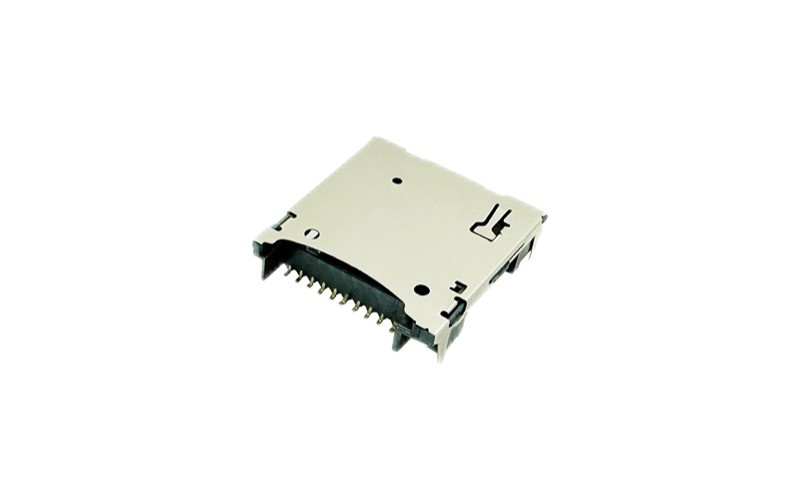
Engineer’s Notebook: Why Standard Connectors Fail First
In industrial, automotive, and embedded systems, storage interfaces are often overlooked—until failure occurs.
TF card connectors (MicroSD connectors) are widely used in:
Industrial control systems
Automotive electronics
UAVs and robotics
Edge computing devices
However, real-world environments introduce challenges such as:
Continuous vibration and mechanical shock
Extreme temperature fluctuations
Dust, humidity, and contamination
Long-term wear from repeated insertion
Engineering research shows that connectors in harsh environments must withstand multiple stresses simultaneously, including vibration, temperature extremes, and environmental exposure. This is where most standard TF card connectors fail—not electrically, but mechanically.
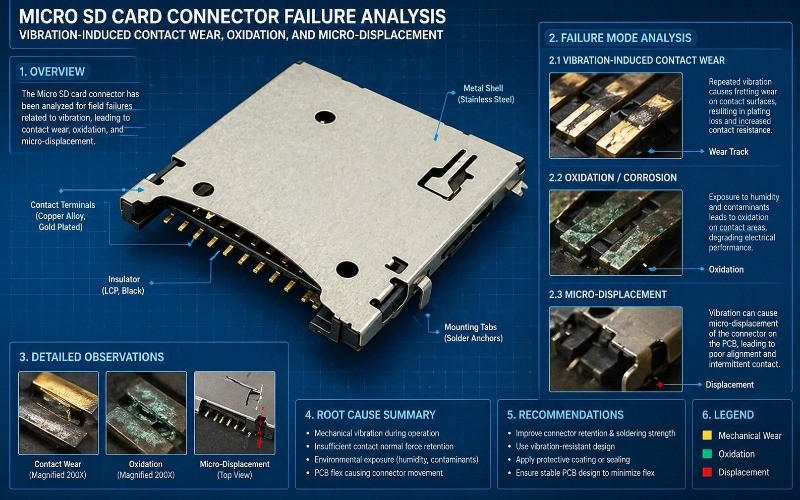
1. Understanding Failure Mechanisms in Harsh Environments
Vibration-Induced Failure
Vibration can cause contact instability, intermittent signal loss, and micro-wear on contact surfaces. Over time, even minimal movement increases contact resistance and leads to system instability.
Shock and Mechanical Stress
Mechanical shock may result in card dislodgement, connector deformation, or solder joint failure. This is especially critical in automotive and industrial systems.
Temperature Extremes
Harsh environments often require operation between -40°C and +85°C or higher. Temperature variation leads to material expansion differences, reduced contact force, and long-term degradation.
2. Engineering Design Strategies for Harsh Environments
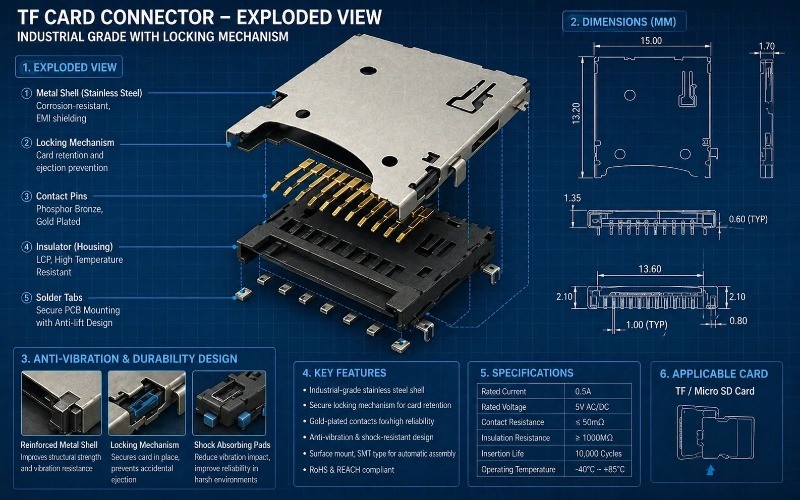
Anti-Vibration Structural Design
Effective solutions include locking mechanisms, reinforced housing structures, and multi-point PCB anchoring. Hinged or locking connectors are preferred in high-vibration applications.
Contact System Optimization
Reliable signal transmission requires high spring force terminals, gold plating for corrosion resistance, and anti-fretting design.
Material Selection
Industrial-grade connectors use high-temperature plastics, metal shielding shells, and corrosion-resistant materials to ensure durability.
Thermal Design Considerations
Design must ensure stable performance across temperature ranges, considering thermal expansion compatibility and long-term material aging.
3. PCB Design Guidelines for Reliability
Connector reliability is closely linked to PCB design quality.
Best practices include:
Keeping signal paths short
Using ground shielding for EMI control
Designing strong mechanical anchoring pads
Avoiding stress concentration near solder joints
Reliable performance requires integration of mechanical, electrical, and environmental design considerations.
4. Testing Standards for Harsh Environment Connectors
Reliable TF card connectors must pass rigorous testing, including environmental and mechanical validation.
Key standards include:
IEC 60068 for environmental testing
Automotive standards such as USCAR-2 and LV214
Important tests include:
Insertion and extraction cycles
Vibration and shock testing
Thermal cycling
5. Industrial vs Consumer TF Card Connectors
Consumer-grade connectors are designed for basic functionality, while industrial-grade connectors are built for reliability in demanding environments.
Industrial connectors provide wider temperature support, stronger vibration resistance, longer lifecycle, and higher overall reliability.
6. Real-World Applications
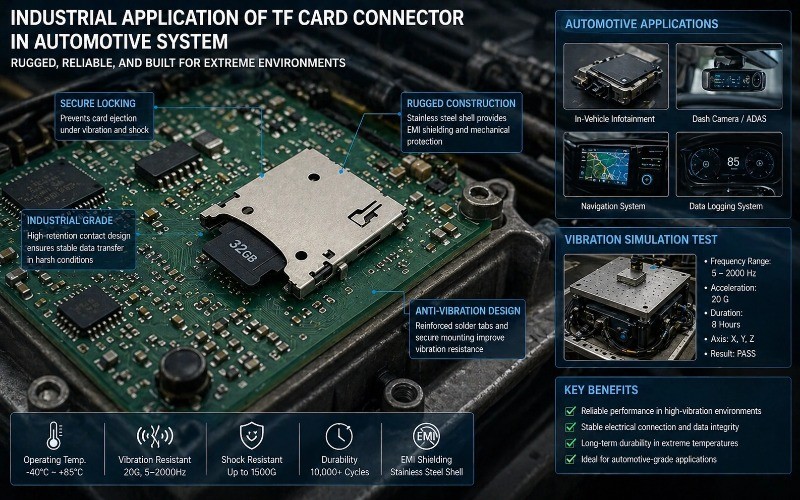
TF card connectors in harsh environments are commonly used in:
Industrial equipment such as PLC systems and data loggers
Automotive electronics including infotainment and ADAS
Robotics and UAV systems with constant vibration
In these applications, connector failure can lead to data corruption or system downtime.
7. Why Choose Moarconn for Harsh Environments
Moarconn specializes in high-reliability TF card connectors designed for demanding applications.
Key strengths include:
Over 16 years of manufacturing experience
Fully integrated production including mold, stamping, injection, and assembly
Custom connector design and ODM capability
Product advantages:
Anti-vibration structural design
High-reliability contact systems
Industrial temperature support
Customizable locking mechanisms
Moarconn solutions are engineered based on real-world failure scenarios, ensuring long-term reliability beyond standard specifications.
8. Final Engineering Checklist
Before selecting a TF card connector for harsh environments, ensure the following:
The connector includes an anti-vibration locking structure
It supports industrial temperature ranges (-40°C or higher)
It provides high mating cycle durability
It has strong PCB anchoring design
It complies with industrial and automotive standards
Summary
TF card connectors used in harsh environments must be designed to withstand vibration, shock, and extreme temperatures. Key design strategies include locking mechanisms, durable materials, and compliance with industrial testing standards to ensure long-term reliability.