What Are SIM Card Connectors? A Comprehensive Engineer’s Overview | Moarconn
- Share
- publisher
- MOARCONN
- Issue Time
- Jun 18,2026
Summary
SIM card connectors enable secure electrical contact between SIM cards and devices, supporting reliable connectivity across telecom and IoT applications.
What Are SIM Card Connectors? A Comprehensive Engineer’s Overview | Moarconn
Meta Title: What Are SIM Card Connectors? Engineer’s Guide | Moarconn
Meta Description: Learn what SIM Card Connectors are, how they work, key design considerations, and how Moarconn’s engineered solutions deliver superior performance for modern electronics.
1. Introduction: Why SIM Card Connectors Matter in Modern Electronics
SIM Card Connectors play a critical role in electronic systems that require secure network identity, mobile connectivity, or removable subscriber modules. From smartphones and tablets to industrial IoT and automotive telematics, SIM Card Connectors bridge the SIM module with the host device, enabling reliable electrical contact and consistent data transmission.
Moarconn (www.moarconn.com) specializes in precision connectors designed for robust performance in demanding applications. This guide helps engineers understand why SIM Card Connectors are essential—and how to choose the right solution.
2. What Is a SIM Card Connector?
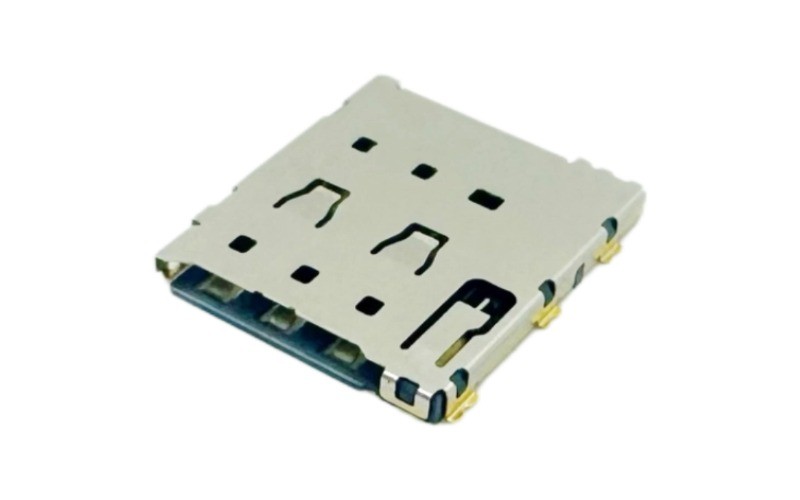
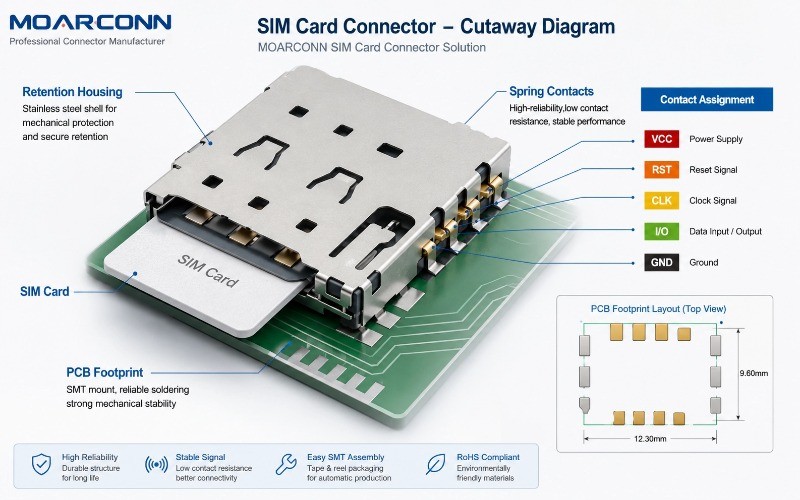
A SIM Card Connector is a specialized electromechanical component that provides a secure and reliable interface between a Subscriber Identity Module (SIM) card and the host device’s printed circuit board (PCB). The connector ensures proper alignment, mechanical retention, and electrical contact between the SIM card’s gold-plated pads and the device circuitry.
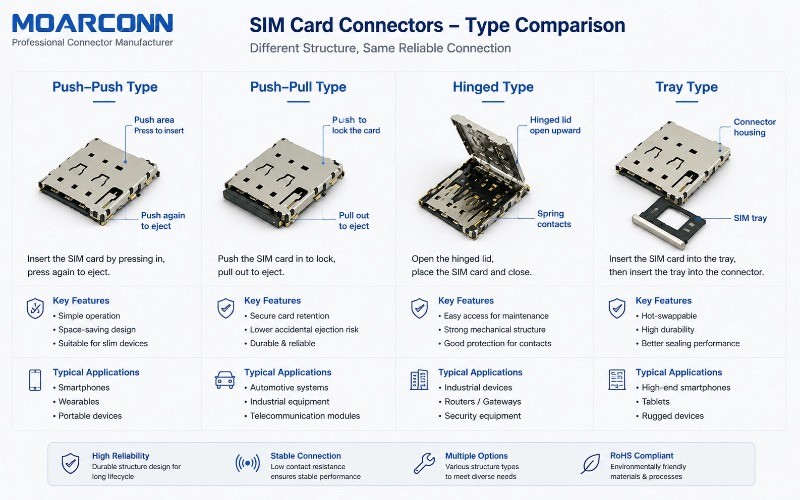
Industry Insight: According to TE Connectivity, SIM connectors support multiple mechanical actuation styles (push-push, push-pull, hinged, etc.) to suit different design constraints and user interactions.
📌 Why SIM Card Connectors Are Important
Provides secure electrical paths for power and signal lines
Ensures reliable data interface for mobile communications
Facilitates serviceability and replaceability of SIM modules
3. SIM Card Connector Anatomy: Electrical & Mechanical Fundamentals
3.1 Electrical Interface
SIM Card Connectors transfer key SIM interface signals including:
VCC (Power Supply)
GND (Ground)
CLK (Clock)
I/O (Data)
RST (Reset)
Precise electrical contact geometry and low contact resistance are critical to maintaining signal integrity—especially in communication systems with rigorous ESD and EMI constraints.
3.2 Mechanical Construction
A typical SIM connector comprises:
Spring contacts with controlled force
Retention housing or tray
Actuation mechanism (push-push, push-pull, hinged)
Each mechanical style affects user experience and design constraints:
Style Description
Push-Push Press to insert / press to release
Push-Pull Push to insert, pull to release
Hinged Flip-type for easy access
Technical Reference: The Asia-Atom overview highlights how SIM Connector mechanics influence card engagement and long-term reliability.
4. How SIM Cards Interface with Devices
At the contact level, SIM cards use standardized gold pads arranged in a specific layout. When inserted into a connector, metallic spring contacts in the connector make low-resistance contact with these pads, enabling direct electrical paths for all necessary signals.
Devices may also incorporate card detection switches and EMI shielding, which enhance user experience and signal integrity.
Design Insight: The SameSkyDevices article explains common connector layouts and how signal paths are maintained during insertion and removal.
5. SIM Card Connector Applications
SIM Card Connectors are used in a wide range of industries:
📱 Consumer Electronics
Smartphones
Tablets
Wearables
🌐 IoT & M2M Devices
Smart meters
Connected sensors
🚗 Automotive Telemetry
Telematics control units
Connected vehicle modules
🏭 Industrial Systems
Data terminals
Remote gateways
Moarconn offers high-precision SIM connector variants optimized for durability, high insertion cycles, and reliable performance in extreme environments—ensuring compatibility with the most demanding applications.
6. SIM Connectors vs Emerging Technologies
While traditional SIM Card Connectors are still widely used, embedded SIMs (eSIM) and integrated SIM (iSIM) are gaining traction. These technologies reduce mechanical complexity but may limit user replaceability.
Moarconn connectors are engineered to support both legacy and modern hybrid solutions, allowing designers to adapt as connectivity standards evolve.
7. Design Tips for Engineers
✔ Electrical Requirements
Contact resistance
Rated voltage and current
EMI/ESD performance
✔ Mechanical Endurance
Insert/withdrawal life cycles
Operating temperature range
Vibration and shock tolerance
✔ PCB Footprint & Assembly
Board space and thickness
Solder pad design
Pick-and-place compatibility
Moarconn provides comprehensive technical documentation and footprint guidelines to ensure design success from prototype to production.
8. Why Choose Moarconn SIM Card Connectors?
At Moarconn, we combine engineering excellence with global manufacturing expertise to deliver connectors that meet the highest standards of performance and reliability.
🌟 Key Advantages
Industry-grade materials and plating
Verified electrical performance
Long mechanical life and robust retention
Full technical support for design integration
Explore Moarconn SIM Card Connectors:
👉 https://www.moarconn.com/category/sim-card-connectors
9. Conclusion
Understanding SIM Card Connectors from both electrical and mechanical perspectives is essential for modern electronic design. These components may be small in size, but they play a pivotal role in connectivity, user experience, and long-term device reliability.
By applying the principles in this guide and choosing quality connectors like those from Moarconn, engineers can confidently design systems that stand up to real-world demands.
Additional Resources
TE Connectivity SIM Connector Product Overview
https://www.te.com/en/products/connectors/pcb-connectors/memory-card-connectors/sim-card-connectors.html
Asia-Atom Mechanical SIM Connector Basics
https://www.asia-atom.com/news_detail/2015481866828611584.html
SameSkyDevices Connector & Interface Insights
https://www.sameskydevices.com/blog/memory-card-connectors-how-sd-sim-and-smart-cards-interface-with-devices