Durability & Reliability of SIM Card Connectors: Testing and Industry Standards
Durability & Reliability of SIM Card Connectors: Testing and Industry Standards
Share
publisher
MOARCONN
Issue Time
Jul 18,2025
Summary
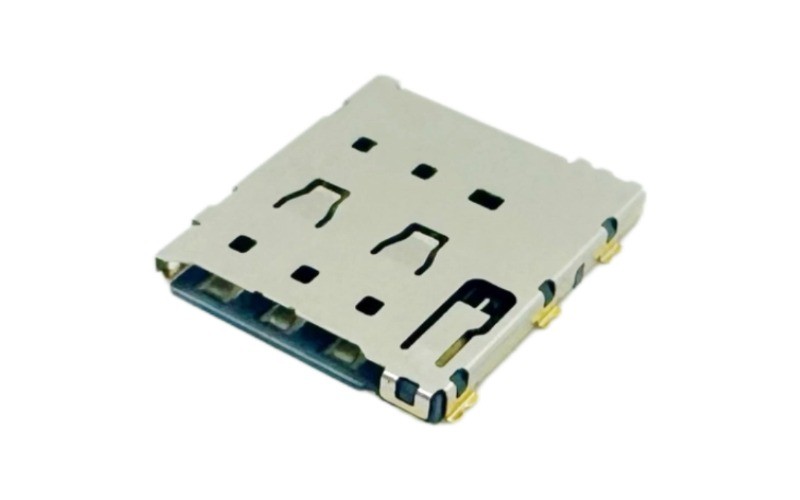
LCP plastic SIM connectors with high contact reliability.
When it comes to SIM card connectors, durability and reliability are more than just technical buzzwords—they are the foundation of secure, long-lasting performance in mobile and IoT devices. As global demand for reliable connectivity rises, understanding how SIM card connectors are tested and evaluated becomes essential for engineers, product designers, and sourcing professionals.
SIM card connectors are subject to frequent mechanical operations—insertions, removals, environmental stresses, and electrical wear. A failure in the connector can disrupt communication, compromise user experience, or even damage the host device.
To ensure stable performance, industry leaders apply rigorous mechanical and environmental testing standards to their connector designs. According to TE Connectivity’s standard document 108-115023, SIM card connectors should pass over 5000 mating/unmating cycles without significant loss in contact resistance or function.
Reliability Evaluation: What Standards Are Followed?
Several organizations have contributed to establishing common reliability frameworks for connector performance:
TE Connectivity (TE): Defines mechanical durability, contact resistance, insertion force, and vibration/shock testing under standard and extreme conditions.
iNEMI: In their 2024 Connector Reliability Report, iNEMI outlines comprehensive methods to evaluate contact retention, corrosion behavior, and connector aging under temperature cycling.
SMTA & Circuit Insight: Provide practical case studies on connector failure analysis, standardized reliability evaluation frameworks, and test repeatability protocols.
These standards guide both component manufacturers and procurement engineers in identifying high-quality solutions for long-term use.
At MOARCONN, we design and manufacture SIM card connectors with a strong emphasis on durability, consistency, and international compliance. All of our products undergo:
Mating cycle tests (up to 5000+ cycles)
High-temperature aging and humidity resistance tests
Contact reliability testing in compliance with IEC 60512 standards
Material traceability audits, especially on metal contacts and LCP plastic components
Our engineers also take customer feedback seriously to continuously improve our product's mechanical resilience in various application environments—from smartphones and smart meters to automotive systems and industrial sensors.
Key Takeaways
SIM card connector reliability is a crucial consideration for device longevity and performance.
International standards from TE, iNEMI, and SMTA guide the industry's approach to evaluating mechanical, electrical, and environmental performance.
MOARCONN integrates these best practices into our production and QC systems to deliver robust, dependable SIM card connectors globally.
Explore our full range of SIM card connectors at www.moarconn.com, or contact our engineering team for product customization.
Every MOARCONN card socket connector is validated to 10,000 mating cycles (tested to GB/T 5095.7-1997; over 2× the 3,000–5,000 cycles common in the industry), operates from -45°C to 80°C, and ships with contact resistance ≤30mΩ thanks to ≥0.025µm gold-plated phosphor-bronze terminals. IATF 16949 certified production supports 0 MOQ orders with 7-day sampling and a 25-day development cycle — backed by in-house mold, stamping and injection molding factories and 32 granted patents.