SD Card Connectors in the SD 8.0 Era: Engineering PCB Layout, EMI Control, and High-Speed Routing Guidelines
- Share
- publisher
- MOARCONN
- Issue Time
- Apr 17,2026
Summary
SD card connectors for SD 8.0 & PCIe-based systems. Learn PCB layout, EMI control, and high-speed design rules.
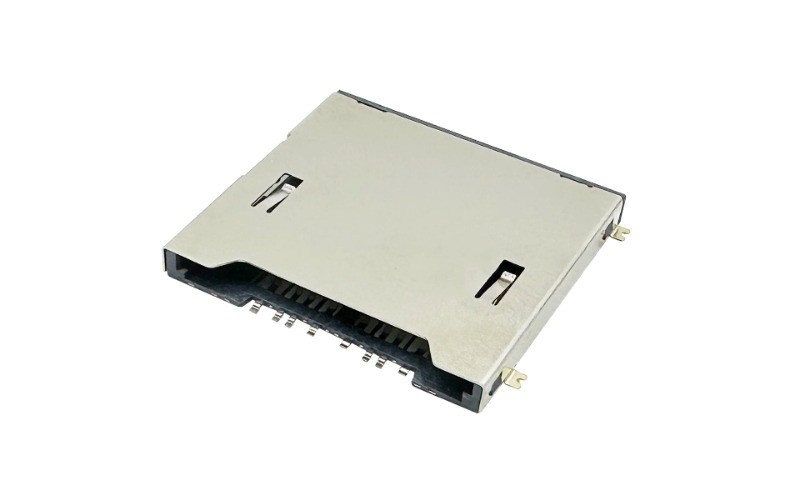
Introduction: SD Card Connectors Are No Longer Passive Components
In modern embedded systems, SD card connectors are no longer simple mechanical interfaces. With the evolution of SD Express (SD 7.0 and SD 8.0), they have become high-speed signal transmission components comparable to PCIe interfaces.
According to high-speed PCB design principles, signal integrity is no longer determined only by ICs or storage media, but by the entire transmission channel—including the connector itself.
At Moarconn , we design and manufacture SD card connectors for industrial, automotive, and IoT applications, focusing on high-speed reliability and long-term durability.
1. SD 8.0 and SD Express: A Fundamental Architecture Shift
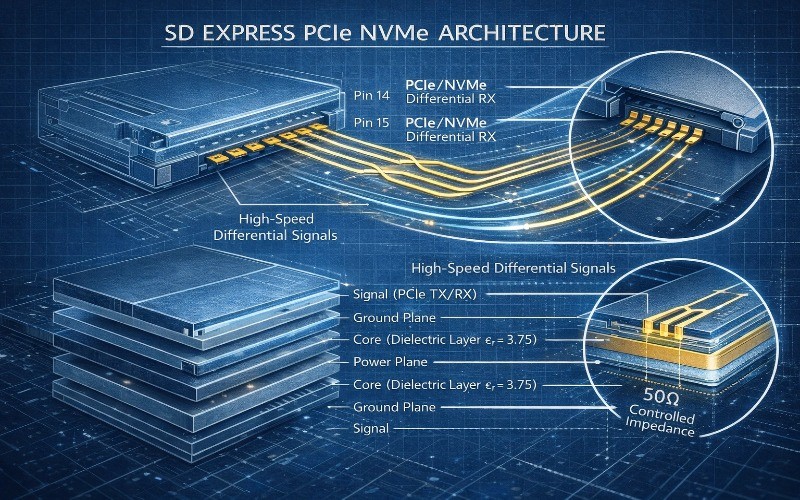
The transition from UHS-I/UHS-II to SD Express introduces a PCIe/NVMe-based architecture:
• From parallel bus to high-speed serial differential signaling
• From MB/s to GB/s-level bandwidth capability
• From low-frequency design to PCIe-class signal integrity requirements
Key Impact on SD Card Connectors
SD card connectors are now part of the transmission line system, not just mechanical interfaces.
Signal integrity risks include:
• Reflection due to impedance mismatch
• Eye diagram degradation
• Increased bit error rate (BER)
• EMI radiation issues
2. PCB Layout Guidelines for SD Card Connectors in High-Speed Systems
2.1 Connector Placement Strategy
Best practices:
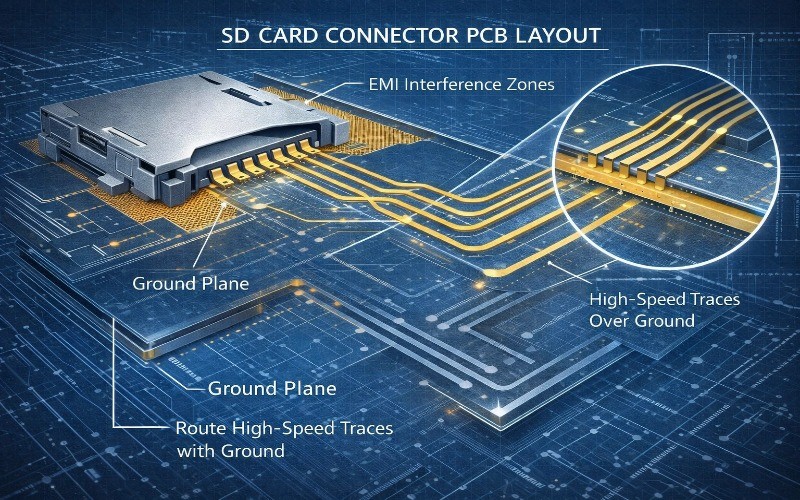
• Place SD connector on PCB edge
• Keep high-speed controller IC within short routing distance
• Avoid noisy power zones
Short routing reduces loop area and improves EMI performance.
2.2 High-Speed Routing Rules
For SD Express (PCIe-level signals):
• Maintain controlled impedance (85Ω–100Ω differential)
• Ensure strict length matching between differential pairs
• Minimize via usage
• Maintain continuous ground reference plane
Moarconn designs connector structures optimized for reduced breakout routing complexity and improved signal stability.
2.3 PCB Stack-Up Considerations
• Stripline preferred for high-speed signals
• Solid ground plane required under connector area
• Avoid split planes under differential pairs
3. EMI and EMC Challenges
At SD 8.0 speeds, EMI becomes a critical design factor.
EMI Sources:
High-speed switching edges
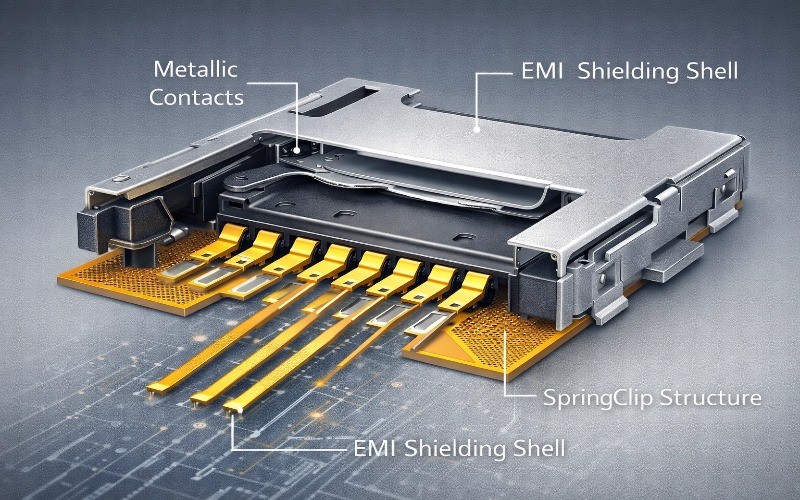
Poor grounding of connector shell
Long signal stubs
Shared return paths
EMI Mitigation:
Ground stitching vias around connector
Short return loops
Isolated power and signal domains
Continuous ground reference plane
4. Signal Integrity Challenges in SD 8.0 Systems
Common failure mechanisms:
Impedance discontinuity
Crosstalk between adjacent traces
Via stub resonance
Return path disruption
Unlike ICs, SD connectors introduce mechanical variability that affects long-term signal stability.
5. Moarconn Engineering Approach
At Moarconn, SD card connectors are designed as system-level high-speed components.
Mechanical Design:
Reinforced PCB anchoring
High-cycle insertion durability
Vibration-resistant structure
Electrical Design:
Low-resistance contact system
Stable impedance geometry
Reduced inductance contact path
EMI Design:
360° shielding structure
Multi-point grounding system
Optimized EMI containment design
6. Common PCB Design Mistakes
Excessive routing length
Missing ground under connector
Poor via management
Placing connector near switching power circuits
Many SD failures are actually PCB-level design issues, not card issues.
7. Future Trend: SD Express in PCIe-Class Systems
SD card connectors are evolving into:
PCIe-like removable storage interfaces
Industrial high-speed modular memory ports
Hybrid embedded storage systems
Future requirements:
Higher bandwidth support
Lower insertion loss
Strong EMI shielding
Precision impedance-controlled structures
8. Moarconn Product Strategy
Moarconn focuses on:
High-speed SD card connectors for SD Express systems
Industrial-grade reliability solutions
Automotive vibration-resistant designs
OEM/ODM customization services
Our mission:
Ensure SD card connectors are never the bottleneck in high-speed systems.