SIM Card Connectors — Complete Buyer’s Guide
- Share
- publisher
- MOARCONN
- Issue Time
- Sep 18,2025
Summary
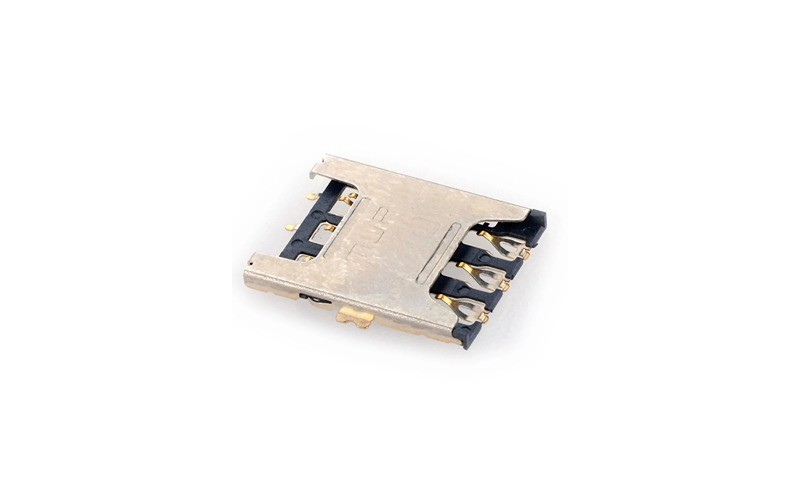
SIM card connectors are essential components that enable devices to access mobile networks reliably.
Introduction
What is a SIM Card Connector?

Types of SIM Card Connectors
Key Considerations When Choosing a SIM Card Connector
Applications of SIM Card Connectors
SIM Form Factors Compared: 2FF, 3FF, 4FF and MFF2
The form factor decides the connector, the footprint, and often the whole enclosure. Four formats are in production today, and a fifth — the soldered MFF2 — is replacing the socket entirely in products that will never be serviced.
| Format | Common name | Card dimensions | Socket height range | Typical use |
|---|---|---|---|---|
| 2FF | Mini SIM | 25 x 15mm | 2.5mm and up | Legacy industrial modems, POS terminals, meters |
| 3FF | Micro SIM | 15 x 12mm | 1.8mm to 2.5mm | Older tablets, routers, telematics retrofits |
| 4FF | Nano SIM | 12.3 x 8.8mm | 1.10mm to 1.43mm | Phones, wearables, IoT modules, 5G CPE |
| MFF2 | Embedded SIM (soldered) | 6 x 5mm | No socket | Sealed IoT devices, automotive, asset trackers |
Two selection rules follow from the table. A socket makes sense when the card must be replaceable by the user or the operator — carrier swap, field service, regional re-provisioning. MFF2 makes sense when the device is sealed, the SIM is provisioned remotely, and every returned unit is a cost. If you are undecided, note that the socket adds roughly 2mm of height and a mechanical failure mode, while MFF2 removes field replaceability permanently.
For new designs the practical default is 4FF Nano SIM: it has the widest supply base, the lowest profiles (MOARCONN's range runs from 1.10mm push-pull to 1.43mm hinge type), and it avoids the 2FF and 3FF parts that are increasingly quoted on long lead times.
Pin Assignment: C1 to C8 and What Each Contact Actually Does
Every SIM socket follows the ISO 7816 contact numbering, and the same eight positions appear in 2FF, 3FF and 4FF connectors. C1 is VCC, the supply from the host, typically 1.8V or 3.0V depending on the card class. C2 is RST, the reset line the host asserts during initialisation. C3 is CLK, the clock the host drives. C5 is GND and must be the first contact to mate and the last to break. C6 is VPP, a programming voltage that modern cards no longer use and that many designs leave unconnected. C7 is I/O, the single-wire bidirectional data line. C4 and C8 are reserved in the classic pinout and are used for the USB interface on some later card generations.
This matters commercially because pin count drives price and footprint. A 6-pin socket carries C1, C2, C3, C5, C6 and C7 — enough for a card that is always present. An 8-pin socket adds card detection, and often a second detect contact for a normally-closed configuration. The delta is small per unit and large in consequence: with hardware detection the modem can stay asleep until a card is inserted, which is the difference between a viable battery life and a marginal one on a cellular IoT device.
Ask for the contact numbering on the drawing rather than assuming it. A socket wired with detection on C4 instead of the standard position will work electrically and fail in firmware integration, and that problem surfaces at the worst possible moment.
Insertion Mechanisms: Where Each Type Fails in the Field
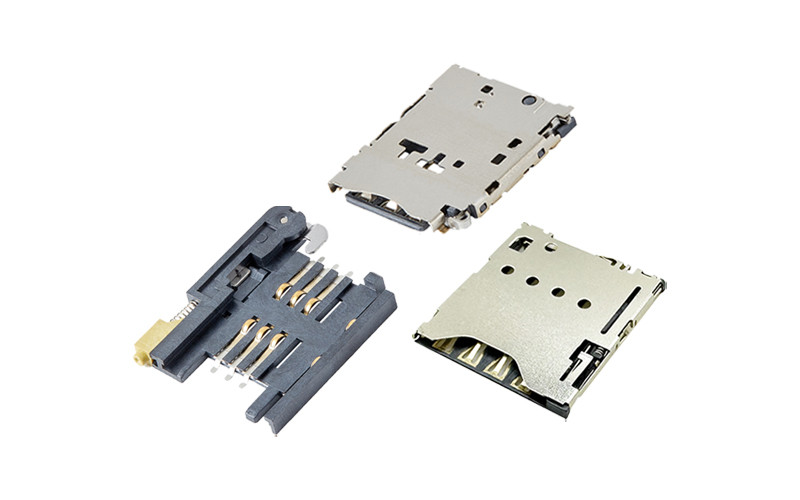
Mechanism choice is usually made on user experience, but the failure modes are what should drive it. Push-push (self-eject) is the most convenient and the most mechanically complex: a spring-loaded ejector with a heart-shaped cam. When it fails — and it does, after a few thousand cycles or one insertion against resistance — the card either will not latch or will not release, and the user cannot recover without opening the device.
Push-pull is the simplest and the cheapest, with no ejector to break. It requires the user to pull the card out with a fingernail, which is fine on a bench instrument and unacceptable on a sealed consumer enclosure. Hinge and flip-lock types expose the contacts for cleaning and inspection, hold the card under spring pressure, and are the usual choice for automotive, metering and industrial equipment where the card is inserted once at commissioning and must survive a decade of vibration.
The tray system moves the mechanism into the product housing and keeps the connector flat, at the cost of an extra part and a second tolerance stack-up. It is the norm on sealed phones and wearables. Whichever type you choose, specify two numbers that predict field behaviour better than any datasheet headline: the insertion and extraction force window, and the cycle rating at that force. MOARCONN holds 3~25N against a national range of 5~40N, and rates 10,000 mating cycles — twice the national requirement — so that insertion feel stays constant across the product's life rather than loosening after the first thousand cycles.
Total Cost of Ownership: Why the Cheapest Socket Costs More
At procurement level, SIM sockets are usually compared on unit price, and the comparison is almost always wrong. Three cost drivers sit outside the quoted price and all three are decided by the connector specification.
Solder yield. Coplanarity decides first-pass yield on a thin board. MOARCONN holds terminal coplanarity at ±0.05mm against the ±0.10 mm common in the industry, with 0.05mm max full-area solder plane flatness. On a 0.8mm board a marginal part lifts pads at the tail end of the panel, and rework on a 1.1mm-pitch connector is manual, slow and often a scrap decision.
Field returns. Contact resistance drift is the failure that reaches the customer as "no service" or "SIM not detected". Phosphor bronze terminals plated to at least 0.025µm gold over nickel hold 30mΩ or less across -45°C to 80°C and through the rated cycle life. A part with half that plating passes incoming inspection and starts failing after a year in a humid enclosure.
Schedule risk. A trading company quoting a socket it does not make cannot tell you why a lot drifted, cannot adjust a housing in two weeks, and cannot hold a sample for traceability. MOARCONN manufactures in-house — mold, stamping and injection — quotes 0 MOQ, 7-day sampling and a 25-day custom development cycle, and keeps samples for 3 years so a return can be traced to its production lot.
Supplier Audit: Eight Questions Before You Place a PO
A supplier questionnaire is only useful if the answers are checkable. These eight are specific enough to separate a manufacturer from a reseller.
- Do you own the mold, the stamping press and the injection machine? If any of the three is outsourced, the response time to a dimensional problem doubles.
- Which quality systems are certified, and can you send the certificate numbers? MOARCONN holds ISO 9001, ISO 14001 and IATF 16949 (certificates T180696 and 0595308), with ISO 16750-3 vibration data for automotive programs and an affiliated mold company holding ISO 13485 for medical plastic parts.
- What is the coplanarity tolerance, and is it measured after reflow? A tolerance quoted on the bare part is not the number your AOI sees.
- What plating thickness and under-plate do you use? Ask for the specification, not the marketing phrase "gold plated".
- What is the sample lead time and the minimum order quantity? 7 days and 0 MOQ are the numbers a project team can plan around.
- Who answers a technical question, and how fast? Original-factory FAE response within 24 hours is a service commitment, not a courtesy.
- Can you support a custom pin layout or housing? 141 models across 13 series means most requirements are a modification, not a new tool.
- Do you retain samples, and for how long? Three years of retention is what makes an 8D investigation possible.
If a supplier answers all eight with specifics and documents, the commercial negotiation is about price. If they answer three and defer the rest, the price is not the risk.
SIM Card Connector Buyer's FAQ
Nano SIM socket or soldered eSIM — which should a new IoT product use?
Use MFF2 if the device is sealed, provisioned remotely, and never needs a carrier swap by the user; it removes a mechanical failure mode and about 2mm of height. Use a 4FF socket if the operator, installer or field technician must be able to change the card, or if the product ships to regions where the carrier is decided at deployment. Many industrial products hedge by fitting a socket and offering an MFF2 variant on the same PCB.
Do I need 6-pin or 8-pin?
Eight pins if the host must know a card is present without polling — which is almost every battery-powered device. Six pins if the card is fitted once at commissioning and the modem can assume it is there. The extra detect contact also gives firmware a clean interrupt to re-run initialisation after a swap, which is worth the pin on anything field-serviceable.
What operating temperature and vibration evidence should I demand?
Match the connector rating to the product's declared range, then ask for test evidence rather than a claim. MOARCONN rates -45°C to 80°C, which covers automotive cabin and industrial cabinet environments, and supplies ISO 16750-3 vibration data for telematics and transport applications. For outdoor or engine-adjacent mounting, say so at RFQ — the plating and housing specification changes.
How do I compare two quotes that differ by 30%?
Put five numbers side by side: plating thickness and under-plate, coplanarity tolerance, rated cycles at the quoted force window, sample lead time, and whether the supplier owns its tooling. A 30% price difference almost always traces back to one of those five, and the cheapest quote usually wins on price while losing on first-pass yield and field returns.
Why Choose MOARCONN?
Conclusion
Recommended Product: Ready to select a SIM connector for your design? MOARCONN's SIM Card Connector 6pin With 2 Detection Pins Push-PushTop Mount Height 1.80mm — 6 signal contacts plus 2 card-detection pins, push-push top mount, 1.80mm low profile. Contact us for datasheets, free samples and custom options.
MOARCONN Quality Anchors
Every MOARCONN card socket connector is validated to 10,000 mating cycles (tested to GB/T 5095.7-1997; over 2× the 3,000–5,000 cycles common in the industry), operates from -45°C to 80°C, and ships with contact resistance ≤30mΩ thanks to ≥0.025µm gold-plated phosphor-bronze terminals. IATF 16949 certified production supports 0 MOQ orders with 7-day sampling and a 25-day development cycle — backed by in-house mold, stamping and injection molding factories and 32 granted patents.