How to Choose a SIM Card Connector for IoT Devices: 7 Engineering and Sourcing Factors
- Share
- publisher
- MOARCONN
- Issue Time
- Jul 17,2026
Summary
Selecting the right SIM card connector for your IoT product? This guide covers 7 key factors: SIM type, pin configuration, ejector mechanism, PCB mounting, durability, sample testing, and supplier sourcing.
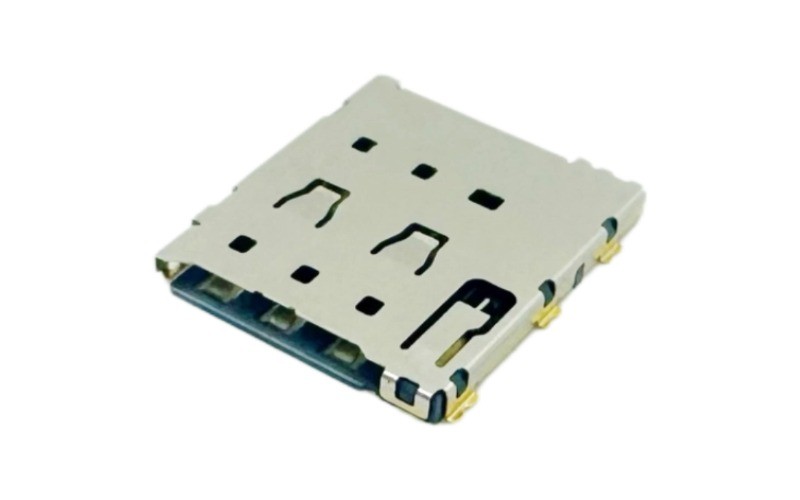
The Internet of Things (IoT) is transforming industries — from smart agriculture and fleet tracking to industrial sensors and connected medical devices. At the heart of many of these devices lies a humble but essential component: the SIM card connector.
Whether your IoT product uses cellular connectivity (4G LTE, NB-IoT, Cat-M1, or 5G) for cloud data transmission, the SIM card connector is the physical bridge between the removable SIM card and your device's PCB. Choosing the wrong connector can lead to signal integrity issues, mechanical failure, or even a complete product redesign late in the development cycle.
In this guide, we walk through 7 critical factors that every hardware engineer and procurement professional should consider when selecting a SIM card connector for an IoT application.
1. Identify the Right SIM Form Factor for Your Device
SIM cards come in three standard physical sizes defined by the ISO/IEC 7816 standard, plus the emerging embedded eUICC (commonly referred to as eSIM) which is supplied in a soldered MFF2 package. For IoT devices, the most commonly used formats are:
| Form Factor | Dimensions | Common IoT Applications |
|---|---|---|
| Nano SIM (4FF) | 12.3mm × 8.8mm × 0.67mm | Wearables, asset trackers, smart meters, portable gateways |
| Micro SIM (3FF) | 15mm × 12mm | Industrial routers, on-board diagnostic (OBD) devices |
| Mini SIM (2FF) | 25mm × 15mm | Legacy systems, base stations (rare in new IoT designs) |
| eSIM / eUICC | Embedded eUICC is commonly supplied in a soldered MFF2 package | Space-constrained devices, automotive telematics |
For most new IoT designs, Nano SIM (4FF) connectors are the preferred choice due to their small footprint. Moarconn offers Nano SIM connectors in both Push-Push and Push-Pull configurations, with board-mount heights ranging from 1.10mm to 3.10mm to suit different enclosure thicknesses.
If your device requires field-swappable SIM cards, a physical connector is essential. If your device is sealed and never opened, an embedded eUICC may be a better option — but bear in mind that it requires carrier profile management infrastructure.
2. Check Pin Count and Electrical Compatibility
Standard SIM connectors use 6 or 8 contact pins, conforming to the ISO/IEC 7816 interface specification. The standard 6-pin interface defined in ISO/IEC 7816 uses pins C1 (VCC), C2 (RST), C3 (CLK), C5 (GND), C6 (VPP), and C7 (I/O). Pins C4 and C8 are reserved or optional. Card detection, if needed, is handled by a separate mechanical detect switch within the connector, not by the electrical pinout.
| Pin | Function | Notes |
|---|---|---|
| C1 | VCC (Power Supply) | 1.8V / 3V / 5V — verify voltage compatibility with your module |
| C2 | RST (Reset) | Controlled by the baseband processor |
| C3 | CLK (Clock) | Typically 1–5 MHz, varies by network standard |
| C4 | Reserved / Optional Interface | Not used in standard ISO/IEC 7816; may be reserved or optional |
| C5 | GND (Ground) | Ensure low-impedance ground plane connection |
| C6 | VPP (Programming Voltage) | Legacy or optional in modern designs |
| C7 | I/O (Data Input / Output) | Bidirectional data line |
| C8 | Reserved / Optional Interface | Not used in standard ISO/IEC 7816; may be reserved or optional |
For detailed pinout diagrams, refer to our guides on Nano SIM Connector Pinouts and SIM Card Connector Pinouts & Electrical Basics.
Key electrical considerations for IoT: Voltage matching — ensure the SIM connector's rated voltage matches your cellular module; contact resistance — lower resistance (under 100 mΩ) improves signal integrity; ESD protection — add TVS diodes near the connector if your device is exposed to frequent handling.
3. Consider Mechanical Mounting: SMT vs DIP
Your PCB assembly process determines whether you need a surface-mount (SMT) or through-hole (DIP) SIM card connector.
SMT (Surface-Mount Technology): SMT connectors are soldered directly onto the PCB surface, saving board space and allowing for smaller device designs. They are compatible with automated pick-and-place assembly, which reduces manufacturing cost for volume production.
DIP (Dual In-line Package): DIP connectors have pins that go through holes in the PCB and are soldered on the opposite side. They offer stronger mechanical retention, making them suitable for industrial IoT devices that experience vibration or frequent SIM card changes.
For most consumer and commercial IoT products, SMT is the standard choice. For industrial gateways and automotive IoT, DIP or a combination of SMT with additional mechanical reinforcement may be preferred.
4. Choose the Right Ejector Mechanism
SIM card connectors use different ejection mechanisms, each suited to different use cases:
| Type | Mechanism | Best For |
|---|---|---|
| Push-Push | Push to insert, push again to eject | Consumer IoT, handheld devices — intuitive and tool-free |
| Push-Pull | Pull tab to remove card | Wearables, compact designs — low profile, no moving latch |
| Hinge | Flip-open lid, card sits underneath | Devices with frequent SIM swaps, test equipment |
| Tray Type | Card loads into a tray that inserts into the connector | High-end smartphones, tablets — best card retention |
For most IoT applications, Push-Push connectors offer the best balance of usability and reliability. Our detailed guide on Push-Push and other ejection mechanisms covers this topic in depth.
5. Evaluate Durability and Environmental Requirements
IoT devices are deployed in diverse environments — from indoor climate-controlled offices to outdoor enclosures exposed to extreme heat, humidity, and vibration. Your SIM card connector must withstand the conditions of your target application.
Key durability factors:
- Insertion cycles: Moarconn SIM connectors are rated for 5,000+ cycles. For applications requiring frequent SIM swaps, choose a Hinge or Tray type for extended life.
- Contact plating: Gold plating offers the best corrosion resistance and signal integrity — particularly important for IoT devices in humid or outdoor environments. Moarconn offers gold, bright tin, and matte tin plating options.
- Material quality: Moarconn connectors use LCP (Liquid Crystal Polymer) for the insulator body and phosphor bronze for the terminals, ensuring stable electrical performance over the product lifespan.
6. Plan for Prototyping and Sample Validation
Before committing to a specific connector model, always request samples and validate them in your actual PCB layout. A seemingly small footprint mismatch can cause assembly issues or signal degradation.
Recommended validation steps:
- Request a datasheet and 2D drawing from the manufacturer — check mating height, pad layout, and keep-out zones.
- Order 5–10 free samples for manual assembly and fit testing.
- Test with your actual SIM card — verify insertion force, card retention, and alignment.
- Validate electrical continuity using a multimeter or test fixture.
- Accelerate aging test (if possible) — test 500+ insertion cycles to confirm mechanical reliability.
Moarconn provides free sample support for qualified IoT design projects. After design finalization, custom samples can be prepared within 25 days.
7. Select a Supplier with Customization and Low MOQ Capability
Not all IoT devices use standard off-the-shelf connectors. Many require custom specifications — whether it is a specific mounting height, a unique ejector angle, a custom PCB footprint, or a particular plating requirement.
When evaluating suppliers, consider:
- Custom design capability: Does the supplier accept custom connector designs based on your PCB layout or physical sample?
- Low MOQ: If your IoT product is in the pilot or early production phase, a supplier that accepts low minimum order quantities is essential.
- Fast sampling: Prototyping speed directly impacts your product development timeline. A supplier that can deliver samples in 2–4 weeks helps you stay on schedule.
- Proven track record: Moarconn was founded in 2010, and its founder has more than 20 years of experience in card-connector engineering.
Learn more about Moarconn at SIM Card Connector product range or custom connector services.
Frequently Asked Questions
What is the difference between a 6-contact and 8-contact SIM card connector?
A 6-contact SIM interface uses C1, C2, C3, C5, C6 and C7. C4 and C8 are reserved or may support optional interfaces depending on the application. Card detection is normally provided through separate mechanical switch terminals on the connector. Always verify the exact terminal layout in the product datasheet.
Can I use a Nano SIM connector in a Micro SIM device?
No — the physical dimensions are different. A Nano SIM is 12.3mm × 8.8mm, while a Micro SIM is 15mm × 12mm. You need a connector that matches your SIM card format.
How do I know if my IoT module needs a 1.8V or 3V SIM connector?
Check your cellular module's datasheet for the SIM interface voltage. Most modern NB-IoT and LTE-M modules support both 1.8V and 3V. The connector does not determine the SIM operating voltage. The cellular module and UICC interface define the operating voltage, while the selected connector must still meet the required electrical ratings.
What is the typical lead time for custom SIM card connectors?
For standard products, samples can be shipped within days. For custom designs, prototype samples typically require 25 days after design finalization. Contact our sales team for a specific timeline.
Does Moarconn offer free samples for IoT design validation?
Yes, Moarconn offers free sample support for qualified IoT development projects. Submit your request through the Free Samples page.
Selecting the right SIM card connector does not have to be complicated. By evaluating these 7 factors — form factor, pin configuration, mounting type, ejector mechanism, durability, sample validation, and supplier capability — you can confidently choose a connector that meets both your engineering requirements and your production timeline.
Moarconn provides SIM card connector solutions for IoT, consumer electronics, automotive, and industrial applications.
For more information, browse our SIM Card Connector range, including Nano SIM Push-Pull connectors and Nano SIM Push-Push connectors, or contact our engineering team.