Nano SIM Card Connector in Modern Wireless & IoT Devices
- Share
- publisher
- MOARCONN
- Issue Time
- Jun 13,2026
Summary
High-reliability Nano SIM card connectors for modern wireless and IoT devices, ensuring compact design and stable connectivity
Nano SIM Card Connector in Modern Wireless & IoT Devices
Engineering-Driven Design, Reliability, and Application Insights
Introduction: Why the Nano SIM Card Connector Matters
In today’s connected world, reliable cellular connectivity is a fundamental requirement for smartphones, IoT devices, wearables, and industrial wireless systems. At the heart of this connectivity lies a small yet mission-critical component: the Nano SIM Card Connector.
As devices become thinner, smaller, and more functionally integrated, the Nano SIM Card Connector has become the industry standard for enabling secure and stable communication between the SIM card and the device’s cellular module. For modern wireless and IoT applications, connector quality directly impacts network reliability, device lifespan, and overall product performance.
What Is a Nano SIM Card Connector?
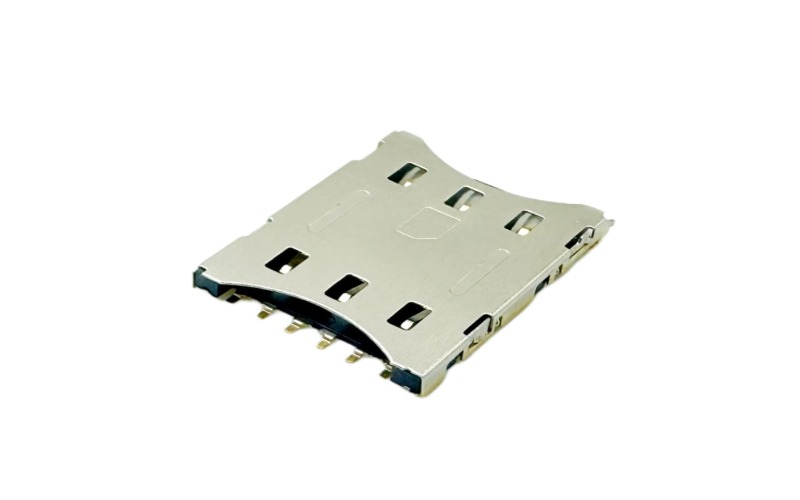
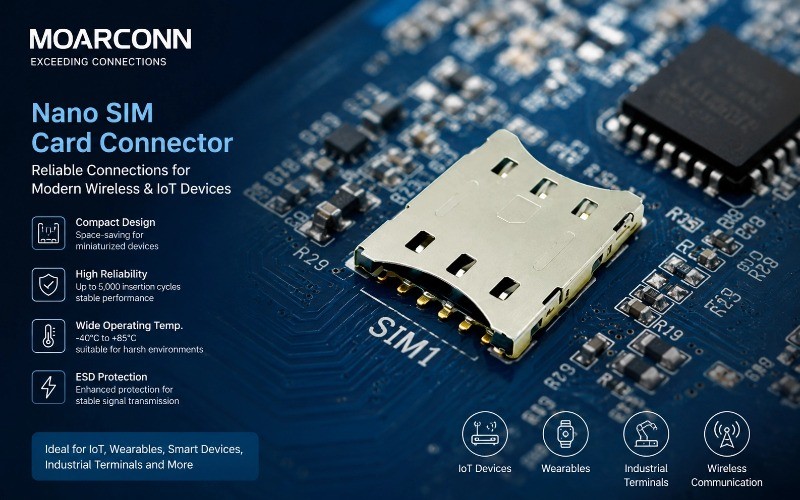
A Nano SIM Card Connector is a compact electromechanical interface designed to connect a Nano SIM (4FF: 12.3 × 8.8 × 0.67 mm) to a device’s PCB. It ensures:
Stable electrical contact for data, power, and clock signals
Secure mechanical retention during vibration and movement
Long-term reliability across thousands of insertion cycles
Compared with Mini and Micro SIM connectors, Nano SIM connectors offer:
Minimal PCB footprint for compact designs
Lower profile height for ultra-thin devices
Improved compatibility with modern wireless modules
These advantages make Nano SIM connectors essential in space-constrained and performance-critical devices.
The Role of Nano SIM Card Connectors in Wireless & IoT Devices
1. Enabling Reliable Cellular Connectivity
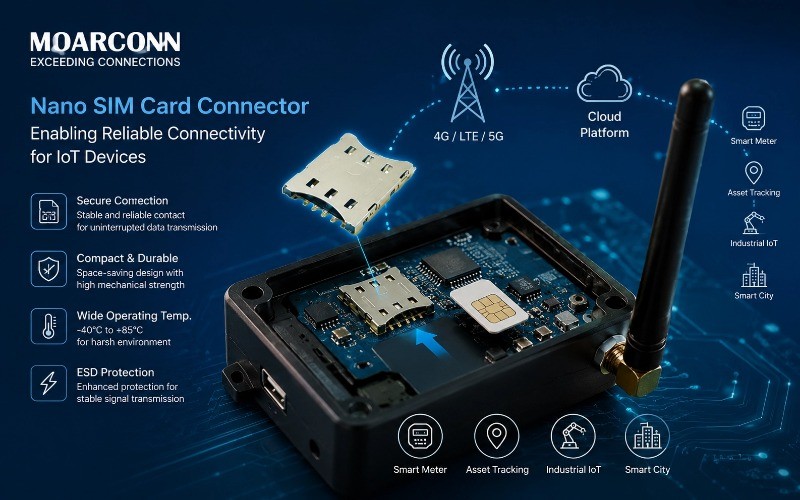
Modern IoT and wireless devices rely on LTE, LTE-M, NB-IoT, and 5G networks for global data transmission. The Nano SIM Card Connector serves as the physical gateway between the SIM card and the modem, ensuring stable signal transmission and consistent network access—even in challenging environments.
Any instability at this interface can result in dropped connections, intermittent data loss, or device failure, making connector quality a non-negotiable design factor.
2. Supporting Miniaturized Device Design
IoT trackers, wearables, smart meters, and portable terminals demand extremely compact layouts. Nano SIM Card Connectors are specifically engineered to:
Fit tight PCB layouts
Support edge-mounted or internal designs
Maintain mechanical strength despite reduced size
This makes them ideal for designers balancing form factor constraints with functional reliability.
3. Ensuring Durability in Harsh Environments
Many wireless and IoT devices operate under harsh conditions, including vibration, temperature extremes, and humidity. High-quality Nano SIM connectors are designed with:
High-performance thermoplastic housings (e.g., LCP)
Gold-plated contacts for corrosion resistance
Robust contact force to prevent signal interruption
These features are essential for industrial IoT, automotive electronics, and rugged devices.
How Moarconn Delivers High-Reliability Nano SIM Card Connector Solutions
With decades of experience in precision connector manufacturing, Moarconn specializes in Nano SIM Card Connectors engineered for modern wireless and IoT applications.
Engineering-Focused Design Excellence
Moarconn Nano SIM connectors are developed with a strong emphasis on real-world engineering requirements:
Long insertion life (up to 5,000+ cycles)
Stable electrical performance across operating conditions
SMT-compatible designs for efficient mass production
Multiple Structural Options for Diverse Applications
To meet different device requirements, Moarconn offers a full range of Nano SIM Card Connector types, including:
Push-Push – user-friendly, self-ejecting mechanism
Push-Pull – simple, robust, and space-efficient
Hinged / Tray Type – ideal for smartphones and consumer devices
Each structure is optimized for reliability, ease of assembly, and mechanical stability.
Industrial-Grade Reliability
Moarconn Nano SIM Card Connectors are designed to meet the demands of industrial and commercial IoT deployments:
Wide operating temperature range (-40 °C to +85 °C)
Strong vibration resistance
High contact reliability under repeated insertion and removal
This makes them suitable for applications such as asset tracking, smart infrastructure, automotive telematics, and industrial gateways.
Engineering Best Practices for Nano SIM Connector Integration
To maximize performance in wireless and IoT devices, engineers should consider the following design guidelines:
1. Choose the Right Connector Structure
Balance device thickness, user accessibility, and expected insertion frequency when selecting push-push, push-pull, or tray-type connectors.
2. Optimize PCB Layout
Place the connector near the PCB edge for easier SIM access
Keep signal traces short to reduce EMI risk
Implement ESD protection near SIM signal lines
3. Focus on Material and Contact Quality
High-quality contact plating and stable contact force are critical for long-term signal integrity, especially in vibration-prone environments.
Future Trends: Multi-SIM, Dual Nano SIM, and eSIM Coexistence
As global connectivity requirements grow, Dual Nano SIM connector solutions are increasingly used in devices that require network redundancy or multi-operator support. These designs are especially valuable in logistics, fleet management, and cross-border IoT applications.
At the same time, eSIM technology is gaining traction. However, replaceable Nano SIM Card Connectors will continue to play a vital role in many IoT and industrial devices where flexibility, field serviceability, and regional SIM changes are required.
Conclusion
The Nano SIM Card Connector is a small but essential component that directly influences the reliability, connectivity, and lifespan of modern wireless and IoT devices. Thoughtful connector selection, engineering-driven design, and proven manufacturing quality are key to successful product development.